
ISO 22000 certification in Bangladesh gives food businesses a way to demonstrate how they manage food safety across their operations. A processor can show how its controls work from receiving to dispatch. A warehouse or logistics provider can demonstrate the controls and records it maintains for the part of the food chain it serves. This guide explains how to define the scope, prepare audit evidence and compare quotations.
Start with one product, one real transaction and the people who handle it. As you follow the product through the site, look for decisions that affect food safety and evidence that shows what happened. The steps below turn that walkthrough into a preparation plan. For an overview of other standards, read the Technotex guide to ISO certification in Bangladesh.
Define the scope around products and activities
ISO 22000 certification in Bangladesh starts with the products and operations your food safety management system will cover. A spice processor may receive ingredients, clean and grind them, pack retail and bulk formats, and dispatch goods through a contracted warehouse. A frozen foods company may operate one facility while outsourcing storage and transport. Write down the legal entity, product groups, locations, activities and responsibilities. Discuss the wording with the certification body and check whether it covers the service or product a buyer intends to purchase.
Follow a recent order from purchasing through dispatch. At each handoff, identify what changes, who owns the decision and where the record lives. Include temporary stock locations, rework, returns and third-party processing. Build a flow diagram with production, quality and warehouse staff, then check it on site on more than one shift when practices vary. The version that informs the hazard analysis should reflect what people actually do. When an alternate route is permitted, document when it is used and which checks apply.
Give each product family a description the team can use during a review. Include relevant ingredients, packaging, expected storage and distribution, intended use and the customers the business supplies. Group products only where the shared description remains accurate. A buyer’s product specification and the site’s process record can provide different pieces of the picture. Where they disagree, assign someone to resolve the difference before relying on the information.
Use a recent change to test the scope maintenance process. For example, when a new customer requests a pack size that your current line cannot produce, the commercial team may arrange outsourced packing. That decision introduces a new handoff, a new supplier and potentially a different record of finished lots. Ask who reviews the change, who checks the first order and how the change is reflected in the documentation the audit team receives. The Technotex guide to ISO certification scope has further questions to ask before finalizing the wording.
Put prerequisite programmes into day-to-day operations
Prerequisite programmes support the operating conditions needed for food safety. Review how the site handles cleaning, maintenance, storage, utilities, personal hygiene, waste and pest management as applicable. Record which work is outsourced and how the organization checks the service. Use requirements and procedures appropriate to your operation, reviewed by competent personnel. A programme is easier to maintain when the operator can see the current instruction and the supervisor can retrieve the record of what happened.
Use cleaning at shift change as a starting point. Ask the outgoing supervisor to identify the equipment cleaned, who carried out the check and which areas remain on hold. Ask the incoming team what it checks before production restarts. When different areas have different release criteria, make the distinction easy to find where the check happens. Review a real record from a busy day and identify the person who resolved any exception. Add an escalation route for decisions that cannot wait for the regular supervisor.
Connect maintenance work orders to restart decisions. The technician can record the completed job and the handover. The designated production or food safety owner can apply the site’s restart procedure and document the result. Review an overnight breakdown where normal staffing was different. Follow the decision to the affected area and product record. This helps confirm whether the procedure works when the people who normally coordinate a restart are away.
Use service reports to make decisions. If a pest management contractor repeatedly flags an issue near a loading bay, ask the site owner to review the conditions and decide what action is needed. Keep the provider report with the record of the decision and subsequent check. The same principle applies to cleaning contractors and building maintenance. The useful evidence shows how the company reviewed the service and followed up on a material concern.
Plan to review programmes when facilities or work patterns change. Examples include a new pedestrian route, a shared cold room, changes to waste collection, or additional operating hours. Decide who updates the procedure, who trains affected staff and when to check that the change has taken effect. If a programme spans multiple shifts, sample more than one shift before marking the update complete. Keep the review record where the owner can find it for the next audit.
Document why each food safety control was chosen
The official ISO 22000 overview explains the purpose of a food safety management system across the food chain. At your site, start the hazard analysis with the verified flow, product description and intended use. Bring in people with relevant knowledge of the ingredients, equipment and production activities. Document the basis for the team’s decisions so they can be reviewed when the product or process changes.
Work through each relevant step. Identify hazards that can be introduced, increased or persist, and record the reasoning for the significance assessment. Distinguish the hazard from the circumstances that may allow it to occur. Keep supporting references tied to the specific assumption they support. For instance, if the assessment relies on a supplier specification, identify which part of the assessment needs review when that specification changes. Where technical judgment is required, involve a competent specialist and record the decision.
Explain the roles of prerequisite programmes, operational prerequisite programmes and critical control points in the site’s own documents. Prerequisite programmes support basic operating conditions. The food safety team determines and categorizes the measures needed for significant hazards using its documented approach and the applicable standard. A template can help organize the assessment, but the justification for each decision should be grounded in the products, equipment and activities in the actual scope.
Make the control records usable for operators. Define where the current instructions are available, who records the result and who can decide what happens if the result falls outside the agreed criteria. A complete record helps the next shift identify any affected material, understand its status and find the decision that authorized release or further action. Review a past deviation with the supervisor to see whether an independent reviewer could reconstruct what happened.
Plan validation, monitoring and verification as distinct activities. Validation considers whether the measures can achieve the intended control under relevant conditions. Monitoring provides the operating result. Verification checks that the planned arrangements are followed and effective. Give each activity an owner, retain the evidence supporting the decisions and set triggers for review. Where a formulation, production method or equipment change affects an earlier assumption, examine whether the supporting evidence is still applicable before releasing the change into routine work.
Connect purchasing, receiving and outsourced services
Build an approved supplier register that shows exactly what each provider supplies. Supplier approval should identify the ingredients, packaging or activities covered, along with any conditions. Give purchasing and receiving staff access to the current rules. Include relevant contract manufacturing, warehousing and transport arrangements in the same review. A change to an outsourced step can affect the reliability of the evidence that the site uses to make a release decision.
Review a delivery that arrived with missing paperwork or an unexpected product reference. Follow the purchase order, receiving record and stock status. Ask who determines whether the goods can be used and confirm how that decision reaches production or the warehouse. If paper labels and inventory software both identify held stock, check that they agree. The record should show the outcome and who authorized it, including where stock was returned or the supplier corrected the paperwork.
Agree the steps for urgent purchases in advance. When the regular supplier cannot meet the schedule, the buyer needs a clear route to request approval for an alternative. Record the specification, reason for the exception, review conditions and end date. After the first delivery, quality and purchasing should check whether the agreement was followed and whether the approval should be extended. This also tells the next buyer what was decided and prevents a one-off approval from quietly becoming normal practice.
During recurring supplier reviews, bring together delivery discrepancies, complaints, specification changes and response times. Check that the people reviewing the supplier can take action when issues recur. A provider may meet its delivery targets while repeatedly sending incomplete information that delays release. Record the agreed action, person responsible and date for follow-up. Check that the updated approval status reaches ordering and receiving staff. It is easier to maintain one current decision than to reconcile old copies of the approved list during an audit.
For external storage or distribution, decide which evidence the provider will retain and how your organization can obtain it. Confirm contacts for exceptions, stock holds and an urgent trace request. Test a recent transaction and note how long it takes to match the provider’s lot or shipment identifiers to your own. Keep the result with the supplier review so that commercial and food safety teams can see whether the handoff meets their needs.
Run a traceability exercise that crosses a real handoff
Select one finished lot and trace backward from dispatch to production and receiving. Identify the finished product reference, quantities and destinations. Follow the record to relevant ingredient and packaging lots, including rework where applicable. Then choose an incoming lot and trace forward to the finished lots and locations it reached. Include stock at external sites when those sites are involved in the actual process. Agree start and finish criteria and record how long evidence retrieval takes.
Reconcile quantities in units that the team can verify. A material may be received in kilograms, issued in bulk and dispatched as cartons. Check what was received, used, held, returned or recorded as loss. Document the conversion and the period covered. If the quantities do not reconcile, identify which record or transaction is missing. Follow the issue to the people responsible and repeat the affected portion once the recordkeeping has been corrected.
Choose an exercise that includes a boundary the business uses, such as an evening dispatch or a transfer to a contracted depot. Ask a depot contact to retrieve the necessary records under clearly identified simulation conditions. Use the normal communication route to check who receives the request, who can retrieve the data and who covers when a key person is away. Keep the test separate from real notification channels where needed to avoid confusion.
Review the difference between finding product and making a withdrawal or recall decision. Traceability identifies affected material and its movement. The response procedure sets decision authority, communication and the handling of affected stock according to the situation. Confirm applicable notification and customer requirements with the responsible staff and appropriate sources. Keep current contact details under authorized access and include a back-up contact in the exercise.
Use the review to improve the system. If customer orders and the warehouse use different identifiers, agree a documented way to match them and assign ownership for maintaining the mapping. If a spreadsheet fills a gap between systems, verify who can update it and how it is controlled. Retest the process with a different lot after making changes so the result demonstrates that the improvement works beyond the original example.
| Record | Examples to check | Typical owner |
|---|---|---|
| Receiving | Supplier lot, material reference, quantities and receipt date | Stores |
| Production | Run reference, input lots, output and quantity changes | Production |
| Off-site storage | Transfer and depot references, held and dispatched quantities | Logistics |
| Customer shipment | Dispatch date, destination and finished lot | Dispatch |
Prepare for internal audit and management review
Build the internal audit programme around the activities in scope and their importance. Include the shifts and outsourced operations needed to see how the system works. Assign auditors who can review the work objectively, define the criteria for each audit and choose a sample that includes exceptions. Reviewing only a clean set of records can miss a recurring problem at a shift handover or during seasonal production. Keep the sample reference so the process owner can understand what the auditor observed.
Write findings so that another person can repeat the check. State the applicable requirement, the evidence sampled and what was missing or did not operate as intended. Assign an owner and due date. Correct the immediate problem, then investigate why it occurred and whether the same issue exists elsewhere. For example, closing one overdue supplier review addresses that record. Checking why the reminder failed and whether other reviews were missed addresses the process behind it. Verify effectiveness with a later sample.
Use management review to decide what needs resources and attention. Bring the important trends, open actions, changes, objectives and feedback to the people who can authorize decisions. Discuss whether the current system supports the operations in scope and what needs to improve. Assign owners for decisions and document when each result will be checked. Technotex’s management review guide offers a starting point for structuring this discussion.
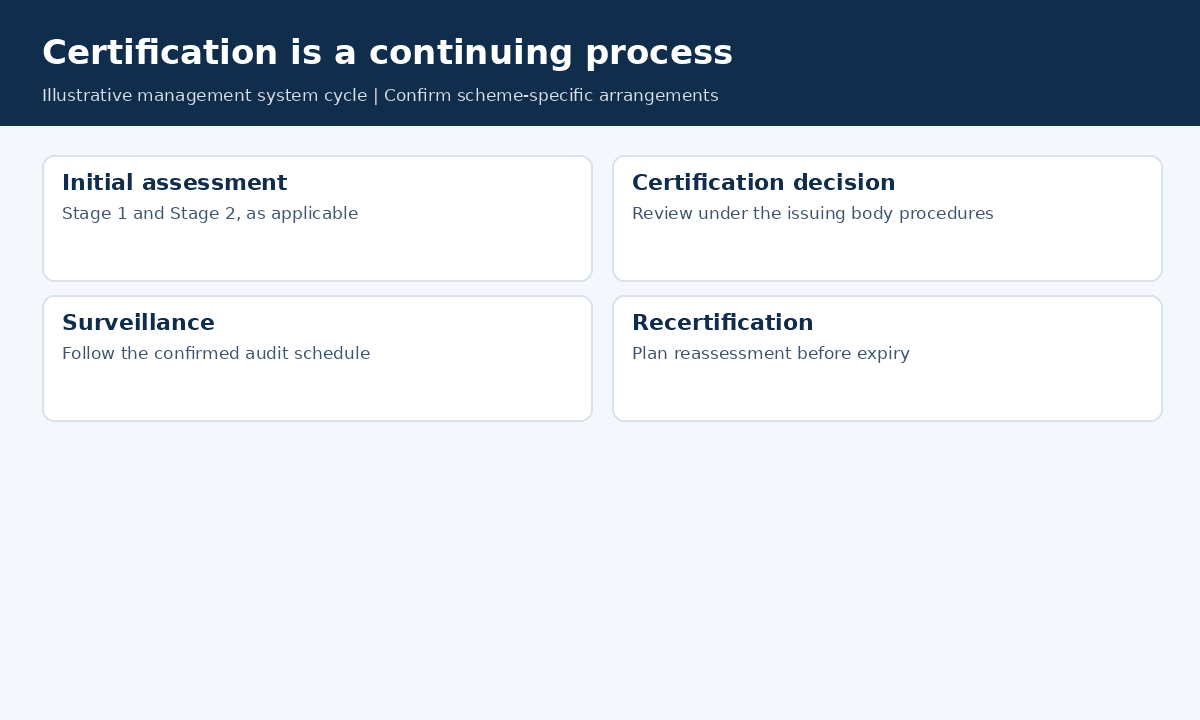
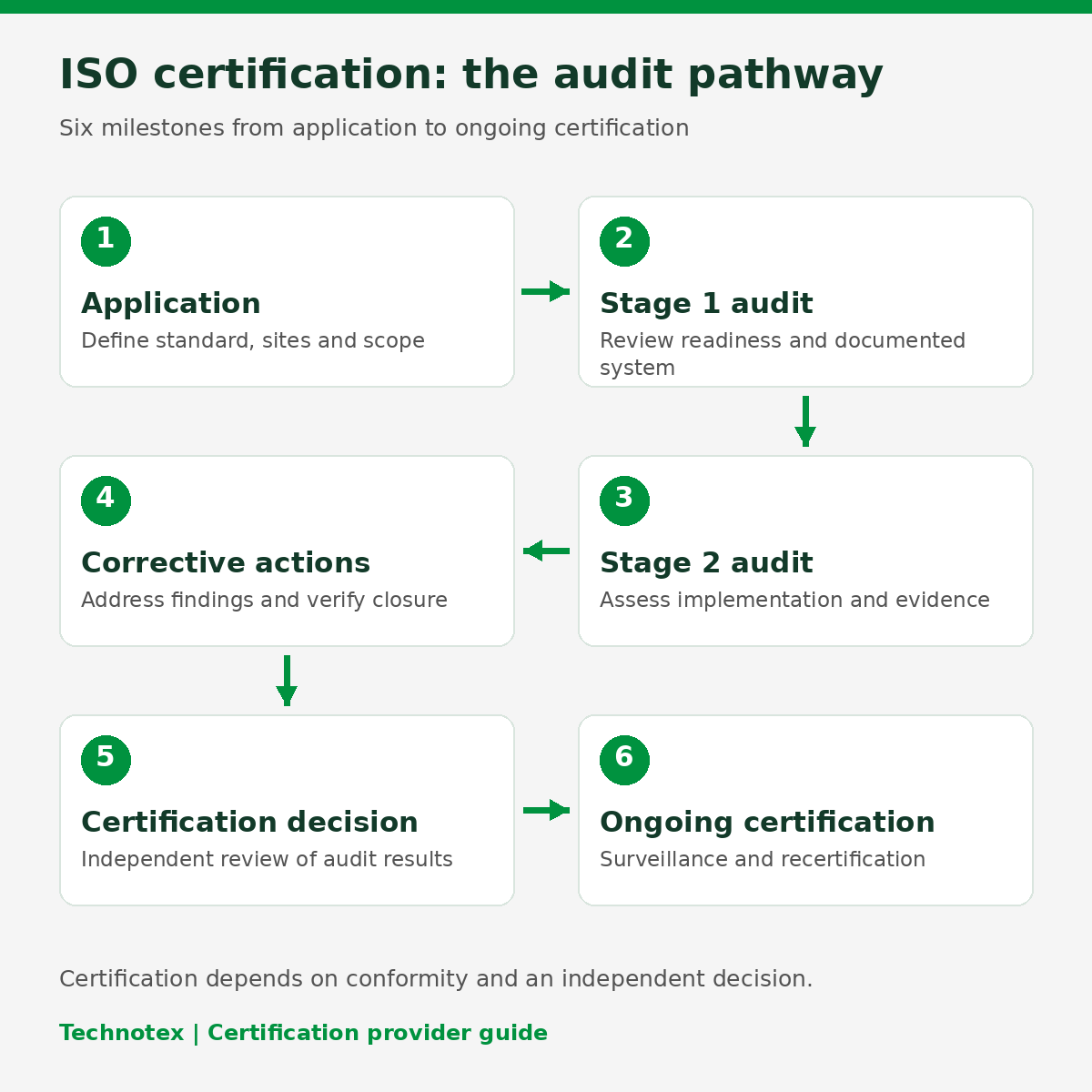
For the initial certification audit, ask the certification body to explain the objectives and arrangements for Stage 1 and Stage 2. Prepare the scope, process map, hazard analysis, planned controls, verification records, traceability evidence, internal audit results and management review. Keep an index that identifies the latest versions and the people authorized to provide access. Discuss site access and any confidentiality arrangements before the visit so that staff can retrieve evidence promptly when it is requested.
Have the process owners practice explaining a real order. An effective walkthrough starts with the transaction and follows it through the relevant records. The supervisor should be able to show how an exception is reported, who decides what happens next and how the decision is recorded. For a broader explanation of the two external audit stages, read the Technotex certification audit guide.
Compare ISO 22000 certification costs and timelines
Give each certification body the same written description of your legal entity, products, processes, locations, staff and shifts. Include outsourced work and distinguish it from operations performed directly. Ask which food chain category and site activities the quotation covers. If your customer requires an accredited certificate or a specific scheme, confirm the exact language early and ask how the issuer’s relevant accreditation scope can be verified.
Ask for separate pricing for the application and initial audits, travel, follow-up, surveillance and recertification when applicable. Confirm whether taxes are included and what could trigger additional audit time. Where a warehouse or a second factory is essential to the service, identify whether the proposed scope includes it and whether a visit is planned. Compare written assumptions before using the headline fee to select a provider. Keep the date and validity period of each quotation in the comparison.
Build an internal budget alongside the quotations. Estimate staff time for mapping the processes, training employees, reviewing technical decisions and running a trace exercise. Include planned changes to records, site practices, supplier controls or equipment where an assessment has identified a need. Assign an owner for the costs and a date to review estimates after the gap assessment. Two organizations can receive similar quotations while facing very different readiness costs.
Work backward from the buyer’s submission deadline. Set milestones for implementing changes, collecting operating evidence, completing the internal audit and management review, and scheduling the external audit. Allow time for responses to findings and for the certification body’s decision process. Confirm expected timing with the provider before promising a certificate date to a customer. The Technotex certification cost guide covers additional questions to ask when building an audit budget.
Keep a record of which decisions affect the timeline. When a product family or site is added, review whether the company has completed the relevant assessments and whether the audit plan needs revision. If the buyer accepts evidence of progress during the application period, confirm the format in writing. When the buyer requires a certificate before awarding the order, include the date and required scope in the project plan so the commercial and food safety teams work to the same requirement.
| Cost item | What to confirm |
|---|---|
| Initial audit | Stage 1, Stage 2, sites and shifts covered |
| Travel and taxes | Included costs and separately billed charges |
| Follow-up | Pricing for additional visits or evidence review |
| Ongoing audit cycle | Surveillance, scope changes and recertification |
Worked example for a packaged food business
Consider an illustrative Bangladesh processor that supplies packaged food to local retailers and an export customer. It receives ingredients and packaging at its factory, packs two formats and sends part of the output to a contracted depot. The company’s first scope statement lists the production address. A review of one actual shipment shows that the depot handles a step essential to lot tracking. The project team documents the relationship and discusses how it should be addressed in the certification scope and supplier controls.
During the traceability exercise, quality staff can find the production records but warehouse staff cannot match one customer order to the depot’s lot number without help from a particular employee. The company adds a common reference to its dispatch instruction, agrees who records it at both sites and tests the change with the next shipment. This creates evidence that a different person can retrieve the affected quantities when the regular employee is unavailable.
The team also discovers that a recent packaging change was communicated by email but the receiving desk still used an older specification. Purchasing corrects the record, checks other recent changes and agrees a documented approval and distribution process. During follow-up, an internal auditor samples a later order to see which specification receiving applied. The result shows whether the correction reached the point where staff made the decision.
Management uses the exercise to prioritize three tasks. The warehouse owner checks that outgoing references are used across shifts. Quality staff update the route for reviewing specification changes. The commercial team confirms the exact wording requested by the export customer. Leadership assigns dates and reviews the first evidence of completion. When it requests an audit quotation, the business can describe the real scope and demonstrate how the controls operate.
After the audit, the team schedules recurring supplier reviews, trace exercises and checks of outstanding corrective actions. It assigns responsibility for telling the certification body about changes that could affect the approved scope or audit programme. More importantly, the process owners keep the evidence in their existing work records. The company can use the same records to answer a buyer’s question, investigate a complaint or prepare for surveillance without creating a separate set of documents for each purpose.
Maintain readiness between audits
Put recurring tasks into the systems where each team already works. Purchasing can track supplier reviews alongside contract renewals. Production can plan checks of shift handovers through its normal supervision schedule. Quality can track the next trace exercise and the effectiveness checks for corrective actions. Where dates depend on a seasonal product run, connect the task to the production calendar so evidence can be collected while the process is operating.
Review measures that help you decide what to act on. Look at how long open supplier issues remain unresolved, whether trace exercises lead to changes in records, and whether repeated findings occur on the same shifts. Identify who supplies each figure and which period it covers. Discuss a meaningful exception rather than relying on totals alone. A rising number of reports can reflect better reporting, recurring problems or both, so check the underlying records before deciding what the number means.
When products, premises or service providers change, ask what earlier decisions the change affects. Review the scope, process map, hazard analysis, training and audit plan where relevant. Inform the certification body about changes that may affect the certification programme, and keep its response with the decision record. Technotex’s surveillance audit guide can help owners plan how they will retrieve the records at the next visit.
Frequently asked questions
What is ISO 22000 certification in Bangladesh?
It is independent certification of a food safety management system against ISO 22000 for the activities in the certificate scope. A food processor, packing operation, storage provider or other organization in the food chain can discuss its proposed scope with a certification body. The audit examines the management system and how the organization applies it in practice.
What are the ISO 22000 certification requirements?
Prepare a defined scope and an operating food safety management system. Typical audit evidence includes verified process flows, hazard analysis, prerequisite programmes, control and verification records, traceability, internal audit, management review and corrective actions. The specific evidence depends on what the company does and how it controls hazards. Keep completed examples from actual shifts, deliveries or dispatches.
How do we get ISO 22000 certification?
Confirm the scope, review gaps, assign a food safety team and implement the necessary controls. Gather records from normal operations, then complete internal audit and management review. Agree the external audit schedule with a certification body and address any findings it raises. The certification body makes the certification decision after reviewing the required evidence.
How much does ISO 22000 certification cost in Bangladesh?
Request a quotation using your product groups, sites, personnel, shifts, outsourced processes and complexity. Compare the initial audit stages, travel, follow-up, surveillance and recertification. Allow an internal budget for implementation and training. A written breakdown makes it easier to see whether differences in price come from the scope of the work or the fees charged.
Does ISO 22000 include HACCP principles?
ISO 22000 uses hazard analysis and control within a wider management system. Confirm the exact evidence your buyer requires, since a buyer can specify particular documents, certification schemes or scopes. Ask for the requirement in writing. This gives the food safety and commercial teams the same basis for deciding what the company needs to demonstrate.
How is ISO 22000 different from FSSC 22000?
ISO 22000 specifies requirements for a food safety management system. FSSC 22000 is a separate certification scheme that builds on ISO 22000 with sector-specific prerequisite programme requirements and additional scheme requirements. Verify the scheme, category and scope your customer requests before choosing a certification route or comparing quotations.
How long does it take to get certified?
The schedule depends on the business’s readiness, scope, audit availability and the time needed to respond to findings. Plan separate milestones for application, operating evidence, internal review, audit stages and the certification decision. Build the schedule with the people responsible for implementation and confirm expected audit dates with the certification body.
Can certification cover outsourced storage?
Discuss which storage activities and locations are within or relevant to the proposed scope. Retain evidence of the responsibilities, records and communications exchanged with the storage provider. Test whether the provider can supply lot and quantity information during a trace exercise. Confirm the wording and audit arrangements with the certification body.
Discuss your food safety certification scope
When you contact Technotex, share your product families, operating locations, staff and shifts, and any buyer requirements. Ask about current audit availability, accreditation scope where required and an itemized quotation.