ISO Certification in Dhaka helps businesses demonstrate that a defined management system has been independently assessed against a relevant international standard. For an organization preparing to approach buyers, strengthen internal processes, or satisfy a specific procurement requirement, the right certification can support confidence in how the business operates.
However, a useful certification project begins long before a certificate is issued. Your organization needs to choose the appropriate standard, define its scope, implement practical controls, maintain evidence, and complete the required audit process. A certificate should reflect a working system, rather than a collection of documents created only for an auditor.
This guide explains ISO Certification in Dhaka from a business owner’s perspective. You will find a standards comparison, a ten-step preparation process, a document checklist, a quotation comparison table, a readiness tracker, a sample performance data table, and answers to common questions. The planning tools are illustrative examples, not official ISO scoring systems or promises of certification.
Whether your business operates from Uttara, Gulshan, Banani, Mirpur, Motijheel, or another part of Dhaka, start with your actual activities and customer requirements. If your head office is in Dhaka but production happens in Gazipur, Savar, or Narayanganj, make sure the certification application accurately describes the relevant operating locations.
Quick answer: What should a Dhaka business do first?
Start by answering three questions: which standard does the business need, which activities and sites must be covered, and who will rely on the certificate? These answers determine the project’s scope, the evidence required, and the certification body you should evaluate.
For example, a buyer might request an accredited quality management certificate covering a particular manufacturing site. A general certificate for the company’s Dhaka trading office may not satisfy that request. Ask the buyer for its exact requirements before accepting a quotation or selecting a certification scheme.
ISO develops standards; independent certification bodies conduct certification. ISO itself does not audit your company or issue your certificate. Certification and accreditation are different: certification concerns the organization’s assessed system, while accreditation concerns the competence of the certification body for specified activities. [1]
The practical starting point for ISO Certification in Dhaka is therefore a clear project brief. Record your business name, activities, locations, employee numbers, intended standard, current system maturity, buyer expectations, and preferred audit window. This brief makes discussions with potential providers much more productive.
1. Understand what certification actually covers
A management system describes how your organization sets objectives, assigns responsibilities, controls activities, checks results, and improves performance. Certification assesses that system against the requirements of the chosen standard within an agreed scope. The scope matters because it identifies the activities and locations included in the assessment.
For a service company, the scope might relate to delivering a defined professional service. For a manufacturer, it might include producing particular categories of goods at identified sites. Neither example should be copied directly into an application without checking that it matches the organization’s real operations.
When planning ISO Certification in Dhaka, avoid wording that is broader than your evidence. A company that imports and distributes equipment should not describe itself as a manufacturer unless manufacturing is genuinely part of the assessed activities. Likewise, a head-office certificate should not be presented as covering every affiliated factory automatically.
Certification also has limits. A management system certificate does not automatically prove that every individual product meets a product specification. It does not replace a buyer’s inspection, laboratory testing, contractual obligations, or applicable operating permissions. Different assessment activities answer different questions, even when they are offered by the same provider.
A useful internal explanation is simple: “We are building a system that produces reliable evidence of controlled work.” That wording helps employees understand why records, responsibilities, and improvement actions matter. It also reduces the temptation to treat certification as a marketing task handled entirely by one administrative employee.
2. Choose the right standard for ISO Certification in Dhaka
Choose a standard because it addresses an actual business need. Begin with customer specifications, operational risks, and strategic priorities. If a tender names a particular standard and edition, confirm the requirements before deciding that a different certificate is an acceptable substitute.
Standards comparison table
| Standard | Main management focus | Example organization considering it | Practical starting question |
|---|---|---|---|
| ISO 9001 | Quality management | Manufacturer, distributor, service company | How do we deliver consistent results and handle customer feedback? |
| ISO 14001 | Environmental management | Factory, warehouse, infrastructure business | Which activities affect the environment, and how are they controlled? |
| ISO 45001 | Occupational health and safety | Construction business, workshop, logistics operation | How do we identify hazards and protect people at work? |
| ISO/IEC 27001 | Information security management | Software company, managed service provider | Which information risks must we assess and treat? |
| ISO 22000 | Food safety management | Food manufacturer, processor, food-chain operator | How do we manage food safety hazards across our activities? |
The table provides a starting comparison, not a recommendation that every company needs all five certificates. ISO’s official pages describe quality, environmental, occupational safety, information security, and food safety management as different management areas. Review the relevant standard before defining your implementation project. [2–6]
Check the edition before you purchase documents
As checked on 6 October 2026, ISO’s official pages list ISO 9001:2026 and ISO 14001:2026. Therefore, older website content describing the 2015 editions as the latest published editions needs review. Existing certificates, transition arrangements, and the edition available under a certification body’s accredited scope should be confirmed separately. [2,3]
For ISO Certification in Dhaka, ask your chosen body to state the applicable edition in writing. Do not assume that publication of a revised standard immediately invalidates every earlier certificate. Obtain the relevant transition guidance and understand how it affects your application, audit plan, and future surveillance activities.
Consider integration when the business case is clear
Some organizations want quality, environmental, and safety systems together. Integration can make internal administration more practical by coordinating document control, management meetings, training records, and improvement tracking. However, each standard still has its own requirements and technical considerations.
Start by identifying common business processes, then map the separate requirements to them. Avoid a large combined manual that staff cannot use. An integrated project should simplify daily work while maintaining clear accountability for each management area. Discuss the audit arrangement and quotation with the certification body before assuming a combined audit will reduce every cost.
3. Build a business case that management will support
The strongest business case for ISO Certification in Dhaka connects certification with an existing problem or opportunity. Examples include repeated customer complaints, unclear purchasing responsibilities, inconsistent project handovers, supplier performance issues, or a documented buyer requirement. Choose outcomes that your team can monitor.
A distributor might focus on reducing incorrect deliveries. A software company might focus on access control and reliable service delivery. A factory might focus on inspection consistency and better tracking of corrective actions. These are illustrative applications; certification does not guarantee any particular improvement percentage.
Write a short statement describing the problem, the intended improvement, the project owner, and the resources required. Include time for managers, supervisors, and operational staff. A system designed without the people who perform the work is likely to create paperwork that nobody follows consistently.
Also consider the commercial limits. A certificate may support supplier evaluation, but a buyer can still assess price, capacity, delivery performance, technical capability, and other requirements. Avoid presenting certification as a guarantee of export orders or automatic eligibility for every tender.
Management should review progress against business outcomes, rather than only asking when the certificate will arrive. Useful questions include whether instructions are clearer, whether records can be retrieved, whether recurring problems have decreased, and whether employees understand their responsibilities. These conversations make certification part of business management.
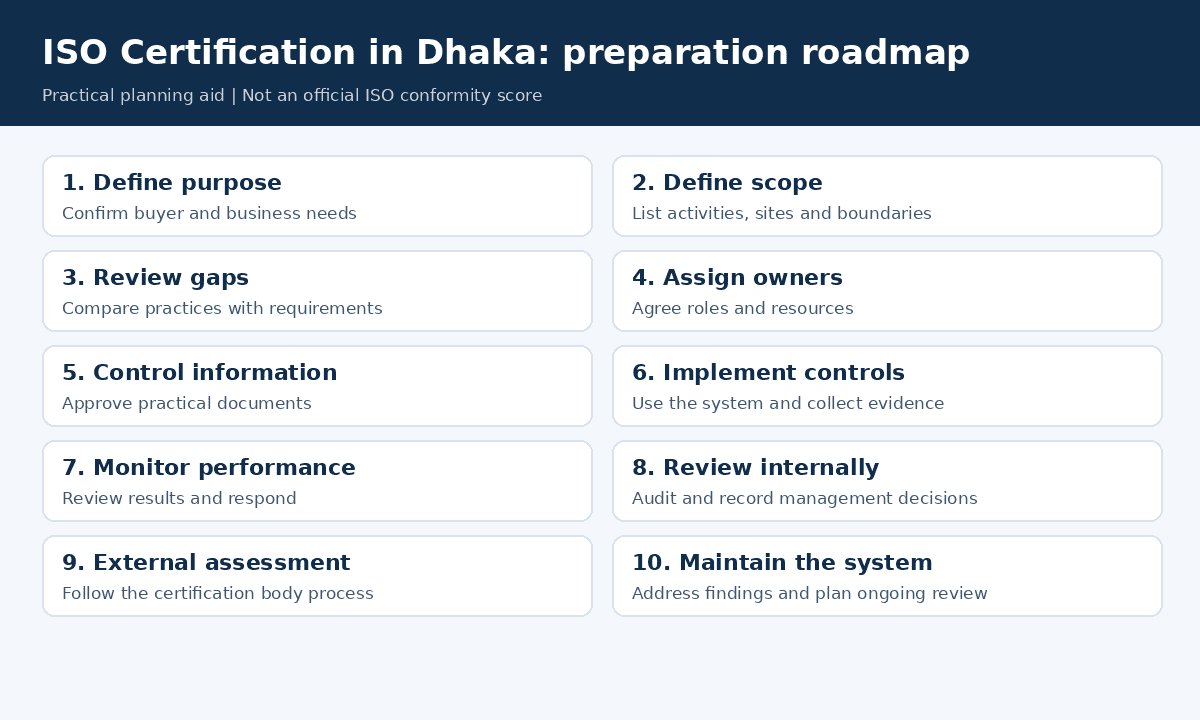
4. Follow these 10 preparation steps
The following roadmap is a practical planning structure for ISO Certification in Dhaka. It is not a replacement for the applicable standard or the certification body’s procedures. Adapt each step to your activities, risk level, locations, and available resources.
Step 1: Define the purpose and intended users
Identify why the organization wants certification and who will use the certificate. List specific customers, procurement teams, business partners, or internal stakeholders where relevant. Ask whether they require accreditation, a specific standard edition, a particular scope, or an approved provider.
Make one person responsible for collecting these requirements. This prevents different departments from making conflicting assumptions. If purchasing decisions depend on certification, keep the buyer’s written requirements in the project folder and review them before committing to a provider.
Step 2: Define activities, sites, and boundaries
Map the products or services delivered, the locations involved, and the supporting functions. Include outsourced activities where they affect the system, and identify how the organization controls those relationships. Be clear about which legal entity is applying.
For ISO Certification in Dhaka, this step is especially useful when the registered office, sales office, warehouse, and operating site are different places. Prepare a location list that distinguishes administrative addresses from operational sites. Let the certification body determine the appropriate assessment arrangement.
Step 3: Compare current practices with requirements
Conduct a structured gap review using the applicable standard and evidence from current operations. Speak with process owners, observe work, and inspect existing records. Identify what already works before designing additional documents.
Record each gap with an owner, a priority, and a target date. Separate a missing document from a missing operational control: creating a procedure does not fix a process that staff cannot carry out. Use the gap review to estimate effort realistically.
Step 4: Assign responsibilities and resources
Identify the senior sponsor, project coordinator, and process owners. Agree how much time employees can spend on implementation and how decisions will be approved. Include resources for training, operational improvements, internal auditing, and any necessary equipment or specialist support.
A coordinator can organize ISO Certification in Dhaka, but cannot personally replace every department’s responsibility. Ask each process owner to explain how the system applies to their work. Document responsibilities in a format people can understand and maintain.
Step 5: Develop practical documented information
Create documents that help people perform and demonstrate controlled work. Use clear titles, version information, approval responsibilities, and retention arrangements. Start with existing forms and improve them instead of introducing unnecessary duplicates.
For example, a purchase approval workflow may need a simple instruction and a record of approval. A customer complaint process may need a register, an investigation method, and evidence of follow-up. The exact documentation required depends on the standard and the organization’s context.
Step 6: Implement controls and collect evidence
Use the system during normal operations. Record training, decisions, inspections, customer feedback, supplier reviews, incidents, or other relevant activities. Check whether employees can retrieve records without relying on one person’s memory.
Meaningful evidence develops through real work. For ISO Certification in Dhaka, avoid filling forms retrospectively to create the appearance of implementation. Where evidence is incomplete, identify the reason, improve the process, and allow appropriate operating time before the external assessment.
Step 7: Monitor performance and investigate problems
Select a manageable number of indicators linked to your objectives. Define the data source, calculation method, reporting frequency, and responsible person. Review unusual results and record what action is taken.
If late delivery increases, examine scheduling, purchasing, staffing, or communication issues instead of changing the target to make the report look better. The aim is a system that helps management understand performance. A dashboard without follow-up decisions adds little value.
Step 8: Complete internal review activities
Plan internal audits that check actual implementation and relevant requirements. Use appropriately competent people and preserve objectivity. Share findings with responsible managers, agree actions, and track them to completion.
Arrange a management review using relevant performance information, audit findings, customer feedback, risks, resource needs, and improvement opportunities. Keep a record of decisions and responsibilities. For ISO Certification in Dhaka, these activities should provide evidence of management involvement rather than only signed meeting attendance.
Step 9: Prepare for the external audit
Confirm the application details, scope, relevant edition, audit dates, locations, and contacts with the certification body. Ensure process owners are available and know where evidence is stored. Review the audit plan and site access arrangements.
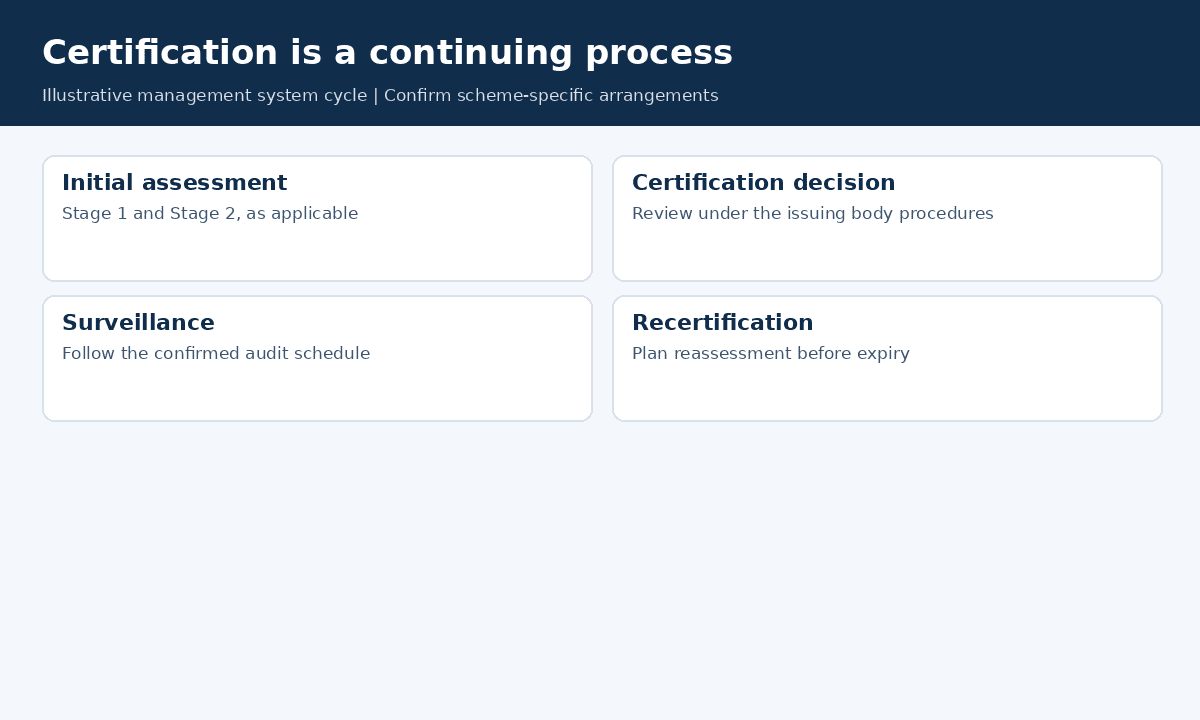
The external certification process commonly includes Stage 1 readiness assessment and Stage 2 assessment of implementation. Findings are reviewed and the certification decision follows the body’s procedures. Obtain those procedures directly so that responsibilities, deadlines, and evidence expectations are clear. [7,8]
Step 10: Respond to findings and maintain the system
If findings require action, investigate the underlying causes and submit the required response within the agreed period. Track what was corrected, what changed, and how effectiveness will be checked. Do not assume that sending a revised document automatically closes every finding.
After a positive certification decision, continue using the system. Plan ongoing reviews, audits, and required surveillance or recertification activities. ISO Certification in Dhaka should support a continuing management routine, rather than an annual rush to recreate missing records.
5. Prepare a useful document and evidence checklist
A document checklist helps organize implementation, but it should not become a claim that every listed item is universally mandatory. Exact requirements vary by standard, scope, risks, and applicable obligations. Use the following table to begin a discussion with process owners.
| Information area | Example evidence to organize | Suggested internal owner |
|---|---|---|
| Organization and scope | Entity details, activities, sites, boundaries | Senior management |
| Policies and objectives | Approved policies, measurable objectives, action plans | Management and process owners |
| People and competence | Role descriptions, training records, competence checks | HR and department managers |
| Operational controls | Instructions, service records, inspection results | Operations |
| Purchasing and suppliers | Approval criteria, purchase records, evaluations | Procurement |
| Customer requirements | Contract reviews, feedback, complaint follow-up | Sales and customer service |
| Risk management | Relevant risks, controls, review decisions | Process owners |
| Monitoring and improvement | Data summaries, findings, corrective actions | System coordinator |
| Internal review | Audit plans, reports, management decisions | Audit team and management |
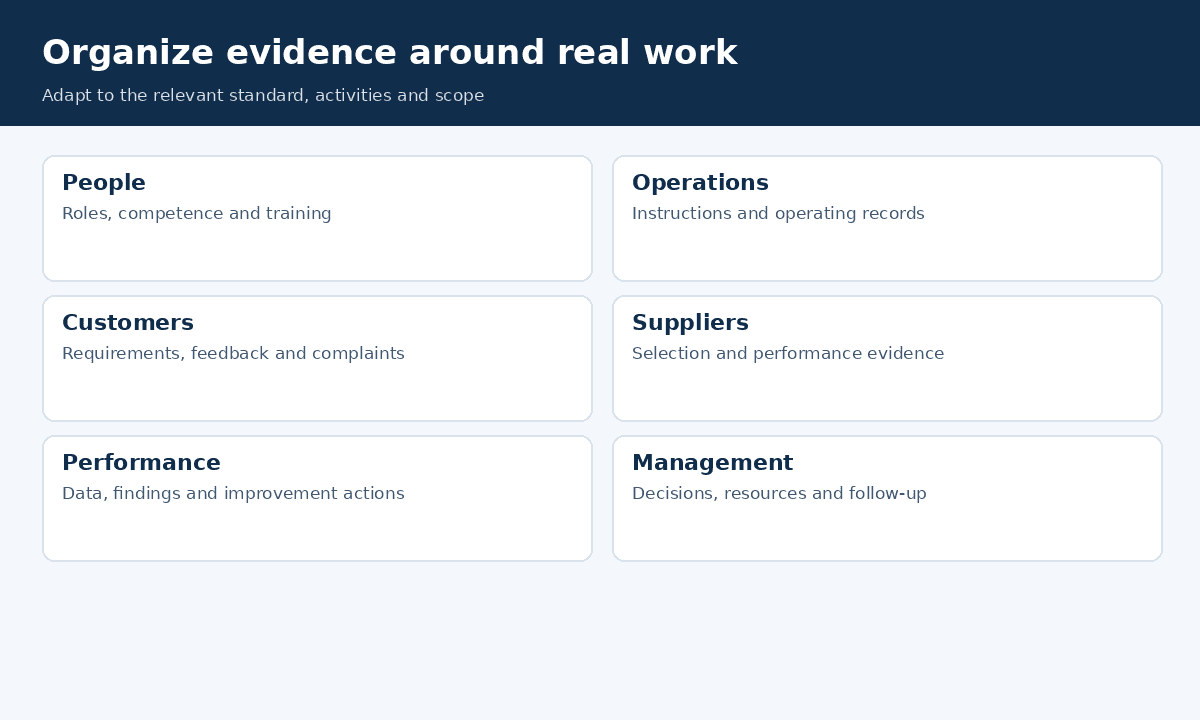
For ISO Certification in Dhaka, store information where employees can access the version relevant to their work. A secure shared folder may be enough for a small organization. More complex operations may need controlled software, but technology should follow the business requirement rather than drive unnecessary expenditure.
Separate active documents from superseded copies. If supervisors use outdated instructions, a tidy central folder will not prevent inconsistent work. Check the versions available at workstations, in printed files, and on mobile devices where staff access procedures.
Create a simple evidence index showing the process, the record location, the owner, and the retention arrangement. Avoid unnecessary personal data in shared folders. Give access according to job needs, and define who can approve changes. Good retrieval practices make both daily management and audit preparation easier.
6. Understand certification cost without misleading price claims
There is no single reliable price that applies to every project for ISO Certification in Dhaka. A small service office and a complex organization operating several production sites may require different audit arrangements and preparation effort. Request a quotation based on a defined scope.
Separate internal implementation costs from certification body fees. Internal costs can include staff time, training, document development, improvements to operational controls, and independent consultancy where used. Certification fees may cover application review, assessment activities, reporting, and ongoing certification management according to the provider’s terms.
Ask for the full expected cycle cost, not only the first payment. A low initial amount may exclude travel, additional visits, surveillance, or recertification. Confirm taxes, payment timing, scope changes, cancellation terms, and any costs associated with follow-up assessments.
Quotation comparison table
| Cost item | What to ask each provider | Your comparison entry |
|---|---|---|
| Initial certification | Which stages and deliverables are included? | Written amount and inclusions |
| Travel and site visits | Are travel and accommodation included? | Included / separate |
| Surveillance | What is the schedule and pricing basis? | Written fee or calculation |
| Recertification | How will renewal be quoted? | Scope and pricing terms |
| Follow-up activity | What happens if further assessment is necessary? | Trigger and fee basis |
| Scope changes | How are new sites or activities assessed? | Change procedure |
| Taxes and payment | What taxes, instalments, and deadlines apply? | Written commercial terms |
For ISO Certification in Dhaka, comparable quotations must describe comparable scope and recognition. Do not compare an accredited certificate covering several sites with an unrelated non-accredited offer for one office and assume the cheaper option provides the same result.
When requesting an estimate, provide accurate information. Understating employee numbers or excluding operational locations can lead to revised quotations and scheduling problems. It is better to clarify the organization’s structure at the beginning than to discover a major scope issue shortly before an audit.
7. Build a realistic schedule
The time required for ISO Certification in Dhaka depends on system maturity, scope, staff availability, required improvements, audit scheduling, and the response to findings. A company with reliable existing controls may need less preparation than a company creating its processes for the first time.
Plan by deliverables instead of promising an arbitrary certificate date. First complete scope definition and the gap review. Then implement controls, collect evidence, review performance, and complete internal assessment activities. Agree the external audit window once the organization can demonstrate readiness.
| Project phase | Evidence that the phase is ready to close | Scheduling dependency |
|---|---|---|
| Scope definition | Approved activities, sites, and standard | Buyer requirements clarified |
| Gap review | Prioritized action register | Access to people and records |
| Implementation | Controls used and records available | Owners and resources assigned |
| Internal review | Findings and management decisions recorded | Sufficient operational evidence |
| External assessment | Audit activities and responses completed | Certification body availability |
| Decision and maintenance | Certification decision and ongoing plan | Required review completed |
Keep a small project buffer for unavailable staff, incomplete records, or additional assessment needs. If a tender deadline is approaching, communicate the deadline early while maintaining honest expectations. A promised delivery date should never replace the necessary assessment and decision process.
8. Track progress with a readiness dashboard
The tracker below is an illustrative planning tool for ISO Certification in Dhaka. The example percentages show how a coordinator might summarize completed tasks. They are not audit results, conformity scores, or evidence that a certificate can be issued.
| Workstream | Illustrative progress | Next action |
|---|---|---|
| Scope and application information | 100% | Confirm details with the certification body |
| Documentation and responsibilities | 80% | Approve two remaining instructions |
| Staff competence and awareness | 60% | Complete remaining role-based checks |
| Operational evidence | 50% | Collect and review further records |
| Internal audit and management review | 20% | Complete planned review activities |
Use a simple calculation: completed agreed tasks divided by total agreed tasks, multiplied by 100. If eight of ten documentation tasks are complete, that workstream shows 80%. Keep the task definitions consistent so that progress is not inflated by splitting easy tasks into many small entries.
An average dashboard percentage cannot establish audit readiness. One unresolved critical issue may matter more than twenty completed administrative tasks. Display significant gaps beside the percentages, with an owner and a due date. This gives management a better picture than a green progress bar alone.
For ISO Certification in Dhaka, review the tracker in a short recurring meeting. Ask what changed since the previous review, what evidence supports completion, and what decision is needed next. Keep the dashboard focused on removing obstacles rather than producing attractive reporting.
9. Use a performance data table that leads to decisions
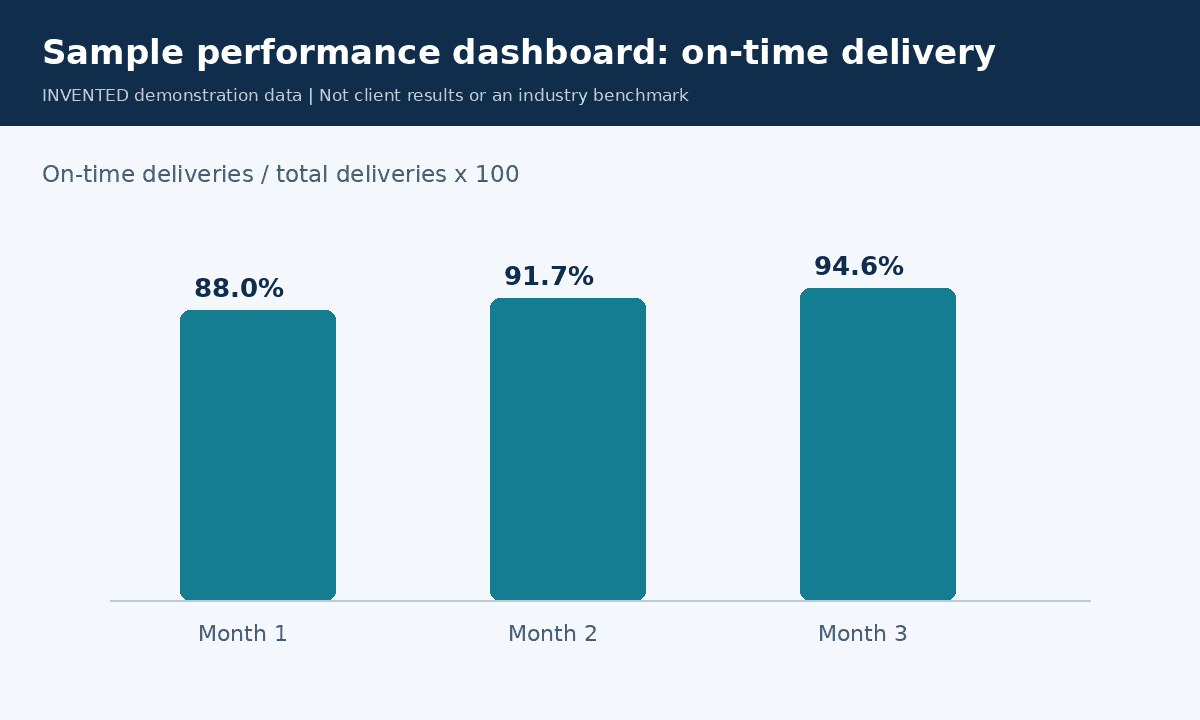
Certification projects should improve the way a business examines its own information. The following table uses invented demonstration data for a hypothetical distributor. It is not Technotex client data, a Dhaka industry benchmark, or a claim about improvements achieved through certification.
| Month | Deliveries completed | Deliveries on time | On-time delivery rate | Complaints received | Actions closed |
|---|---|---|---|---|---|
| Month 1 | 100 | 88 | 88.0% | 8 | 5 |
| Month 2 | 120 | 110 | 91.7% | 6 | 6 |
| Month 3 | 130 | 123 | 94.6% | 4 | 7 |
Calculate on-time delivery as deliveries on time divided by deliveries completed, multiplied by 100. In Month 2, 110 divided by 120 gives approximately 91.7%. Define what counts as “on time” before collecting data, including how rescheduled customer requests are handled.
In this illustration, actions closed in Month 3 exceed new complaints because the team might close older actions. That does not necessarily mean every current complaint is resolved. Record opening dates, owners, status, and evidence of effectiveness in the underlying action register.
For ISO Certification in Dhaka, the most useful data table is one that supports your own objectives. A software company may track incidents and response times. A manufacturer may track nonconforming output and inspection results. An environmental team may monitor relevant resource use, while a safety team may examine incidents and control checks.
Always look at the context behind a trend. A higher percentage can result from a changed measurement rule, a different product mix, or lower workload. Discuss the explanation before attributing an improvement to a particular initiative. Accurate definitions and honest interpretation make performance evidence more credible.
10. Evaluate a certification body carefully
When comparing providers for ISO Certification in Dhaka, assess competence, impartiality, scope, recognition, communication, and commercial clarity. Ask the provider to explain how it will assess your organization and how certification decisions are made.
Use these questions during your evaluation:
- Can you assess our intended standard, edition, technical sector, and sites?
- Is the proposed certification accredited, and what evidence supports its exact scope?
- Will our customer or tender authority accept this certification arrangement?
- How are audit planning, reporting, findings, and follow-up managed?
- How are confidentiality and conflicts of interest controlled?
- How can customers verify certificate details and current status?
- What complaint and appeal procedures are available?
- What is included in the complete quotation and continuing certification cycle?
Check accreditation with the relevant accreditation body rather than relying only on a badge displayed on a website. Recognition can depend on the specific accreditation arrangement and the recipient’s requirements. Never assume that one accreditation name guarantees acceptance by every buyer, authority, or overseas market.
Where consultants assist implementation, understand how their role is separated from independent assessment and decision-making. BSI’s certification information, for example, explains restrictions where consultancy has been provided within its group for the same management system. The practical lesson is to ask direct questions about independence. [8]
Request clear written terms before making a payment. A provider should be able to describe its process without promising automatic approval. An audit may identify findings, and certification depends on the applicable assessment and decision requirements being satisfied.
11. Verify the certificate and communicate it accurately
After ISO Certification in Dhaka, check that the certificate correctly identifies the organization, assessed activities, relevant sites, standard and edition, certificate number, issuing body, and applicable dates. Report errors promptly and keep the corrected approved version under control.
When a buyer requests verification, use the issuing body’s official channel or the applicable accreditation register. Some accredited certificates can be checked through IAF CertSearch; the available verification route depends on the certification arrangement. Contact the issuing or accreditation body if a record is unclear. [1]
Avoid making a website statement broader than the certificate. If a defined service activity is certified, describe that activity accurately. If one location is covered, avoid implying that every branch is included. Give customers an accessible route to ask for the certificate or verify its status.
Do not create an unofficial ISO logo to advertise certification. Use authorized certification marks only according to the issuing body’s rules. Review marketing materials, quotations, email signatures, and packaging so that the wording consistently reflects what was actually assessed.
12. Maintain the system after certification
Ongoing maintenance is part of ISO Certification in Dhaka. Keep responsibilities active, update documents when work changes, and continue collecting performance evidence. Make the system part of regular department routines so that it does not depend on one coordinator preparing everything before a visit.
Management system certification commonly operates through a cycle including initial certification, surveillance, and recertification. Bureau Veritas describes a generally three-year program, with surveillance and reassessment requirements. Your own certification body should confirm the schedule, obligations, and applicable scheme conditions. [7]
Tell the certification body about significant organizational changes according to its rules. Examples to discuss include new sites, changed activities, a different legal entity, or major operational changes. Do not assume a certificate automatically expands when the business grows.
Maintain a calendar for internal reviews and external certification activities. Review recurring findings, overdue actions, employee competence, customer feedback, and resource needs. If a process repeatedly fails, revisit the control rather than only asking employees to complete more forms.
Store the certification agreement, audit reports, correspondence, and current certificate where authorized people can retrieve them. A business should be able to answer a verification request even when the coordinator is absent. This is a practical test of whether certification has become part of normal organizational management.
13. Avoid common mistakes that delay progress
The first common mistake is selecting a provider before clarifying buyer requirements. This can leave a business with a certificate that does not cover the requested activity, location, or recognition arrangement. Confirm the intended use before comparing prices.
The second mistake is copying another company’s procedures. A template may help structure a document, but instructions must reflect your actual work. Employees should recognize the workflow described and be able to demonstrate it using current records.
The third mistake is assigning the whole project to administration. ISO Certification in Dhaka requires participation from the people responsible for operations, purchasing, sales, HR, technical work, and management, as relevant. The coordinator’s role is to organize the project, not invent evidence for every department.
The fourth mistake is ignoring findings after an audit. An action register should show ownership, the response, and evidence that the issue was addressed. Repeating the same problem suggests that the previous response did not change the underlying process sufficiently.
The fifth mistake is treating a certificate as a promise of business success. Certification can support credible communication, but customers still judge performance. Keep your claims specific and explain the assessed scope when discussing the certificate with a buyer.
The sixth mistake is maintaining several conflicting versions of records. Decide which record is authoritative, who updates it, and where supporting evidence is stored. Duplicated spreadsheets and disconnected email approvals often create confusion that could be prevented with a simpler controlled arrangement.
14. Prepare a Dhaka-specific application brief
Before requesting ISO Certification in Dhaka, prepare a short application brief that accurately explains your operating structure. Include the company’s legal name, contact person, business activities, locations, employee numbers, shifts, outsourced processes, and intended certification standard.
If your Dhaka office coordinates a factory elsewhere, explain the relationship clearly. Identify which functions operate at each location and which sites should be included. Give the certification body enough information to plan assessment coverage without guessing.
Consider practical scheduling conditions. Discuss site access, working hours, production schedules, visitor safety requirements, and the availability of key employees. If staff use Bangla records or communicate primarily in Bangla, clarify language arrangements for the audit team and report before the visit.
Provide relevant buyer requirements and deadlines, while distinguishing a preferred timeline from confirmed readiness. Share the actual state of implementation, including any completed internal audits or existing certification. Accurate information supports a more useful quotation and a realistic project plan.
15. Discuss your certification requirements with Technotex
Businesses exploring ISO Certification in Dhaka can contact Technotex Testing & Quality Assurance Limited to discuss the relevant standard, intended scope, operating sites, and assessment requirements. The company’s services page describes independent management system certification and states that accredited certification is provided within its approved scope. [9]
You can explore Technotex certification and assessment services, review the ISO 9001 service information, or use the contact page to request a discussion. Confirm the proposed standard edition, accreditation coverage, recognition requirements, and quotation before proceeding.
Technotex lists its Bangladesh office at House 76, Road 17, Sector 14, Uttara, Dhaka-1230. Its published contact details include info@technotex.co and +8801711033896. Use the contact page for the latest details and to describe your organization’s requirements. [10]
To receive a more relevant response, send a brief covering your organization’s activities, sites, workforce, desired standard, current system status, and customer requirements. Ask for a written proposal explaining scope, assessment stages, costs, and ongoing certification arrangements. A clear enquiry supports an informed decision.
16. Frequently asked questions about ISO Certification in Dhaka
What is ISO Certification in Dhaka?
It generally refers to certification services for organizations operating in Dhaka, where an independent body assesses a defined system against a relevant ISO standard. The certificate relates to the stated scope. Location does not replace the need to define the activities, sites, and standard being assessed.
Which ISO standard should my business choose?
Choose according to your activities, risks, and customer requirements. Quality management may lead you to consider ISO 9001, while information security may lead you to ISO/IEC 27001. Review the actual requirements before applying, and do not purchase several certificates without a clear business reason.
Is ISO 9001:2015 still the latest published edition?
No. As checked on 6 October 2026, ISO’s official page lists ISO 9001:2026. If you hold an earlier certificate or are starting a project, ask your certification body which edition applies to your arrangement and what transition guidance you need to follow.
Is ISO 14001:2015 still the latest published edition?
No. ISO’s official page lists ISO 14001:2026. Confirm the relevant transition arrangements and the edition supported under your certification body’s scope. Do not assume that an earlier certificate is automatically invalid simply because a revised standard has been published.
Does ISO itself issue my company’s certificate?
No. ISO develops international standards and does not issue your organization’s certification. Independent certification bodies perform that activity. When evaluating an offer, identify the actual issuing body and how the certificate can be verified.
How much does ISO Certification in Dhaka cost?
Cost depends on the defined project, including the standard, activities, locations, workforce, assessment arrangement, and ongoing certification terms. Request a written quotation that separates initial assessment, travel where applicable, surveillance, recertification, taxes, and additional visits. Compare offers using the same scope and recognition requirements.
How long will certification take?
The timeline depends on readiness, implementation effort, operational evidence, staff availability, audit scheduling, and responses to findings. Agree milestones after a gap review. A short advertised turnaround is not sufficient evidence that your organization has met the assessment and certification decision requirements.
Can a small business apply?
A small organization can explore certification where the relevant standard is appropriate to its activities. Design documentation and controls proportionately. A smaller workforce does not remove the need for clear responsibilities, effective implementation, and evidence that the management system operates as intended.
Can a service company get ISO Certification in Dhaka?
Yes, management system certification is not limited to manufacturing. A service business should choose a suitable standard and define its scope accurately. Evidence might relate to reviewing customer requirements, delivering services, handling complaints, managing competence, or controlling information, depending on the system.
Do we need a consultant?
A consultant is not automatically necessary for every organization. Some businesses implement systems using their own competent staff; others seek independent implementation assistance. Consider the complexity of the requirements, available knowledge, and resources. Clarify how consultancy remains separate from independent certification assessment and decision-making.
Can our Dhaka office certificate cover a separate factory?
Only when the certification arrangement actually includes the relevant activities and sites. An office address on a certificate does not automatically demonstrate coverage of a separate production location. Discuss the full organization structure and obtain clear scope information from the issuing body.
What is the difference between Stage 1 and Stage 2?
Stage 1 commonly assesses readiness and relevant system information. Stage 2 evaluates implementation. Your certification body will define the applicable assessment plan and requirements. Prepare employees, records, and site arrangements for both stages rather than treating the first stage as a guarantee of approval.
What happens if the auditor finds a problem?
The finding should be handled according to the certification body’s rules. Investigate the issue, provide the required response, and submit appropriate evidence within the agreed timeframe. Clarify how the body will review the response and whether additional assessment is necessary before a certification decision.
Is accreditation important?
Accreditation provides independent recognition of a certification body’s competence for specified activities. Its relevance depends on your intended certificate use and recipient requirements. Verify the exact accreditation scope and ask your buyer or tender authority whether the proposed arrangement is acceptable.
Will the certificate be accepted by every international buyer?
Acceptance should never be assumed. Buyers may specify standards, editions, accreditation arrangements, scopes, or approved providers. Obtain those requirements before choosing a certification body. An impressive logo or a general claim of global acceptance is not a substitute for checking the actual contract conditions.
Does certification guarantee a tender award?
No. Even where a relevant certificate is requested, an award can depend on other technical, commercial, administrative, and eligibility requirements. Read the specific tender documents. Present certification accurately as one part of your supporting evidence, rather than a guarantee of selection.
How do I verify a certificate?
Check the certificate number, issuing body, organization name, scope, sites, standard, dates, and current status through appropriate official channels. Use the issuing body’s verification service or a relevant register where available. If the result is unclear, contact the issuing or accreditation body directly.
Can we advertise that all our products are ISO approved?
A management system certificate should not be described as automatic approval of every product. Check what was assessed and follow the issuing body’s rules for certification claims and marks. Product testing, inspection, and product certification are separate activities with their own scope and evidence.
What happens after a certificate is issued?
Continue operating the system, reviewing results, handling problems, and maintaining evidence. Follow the certification body’s surveillance and recertification arrangements. Keep it informed of significant changes as required, and avoid presenting an expired, suspended, or out-of-scope certificate as current assurance.
How can I start with Technotex?
Use the published contact page and describe your activities, sites, workforce, preferred standard, and intended certificate use. Ask for confirmation of the applicable scope, edition, assessment process, and quotation. This gives the team the information needed to discuss your ISO Certification in Dhaka requirements.
17. Your next step
Begin ISO Certification in Dhaka by preparing a clear scope and a realistic implementation plan. Select the standard that matches your needs, involve the right process owners, and use evidence from daily operations to guide the work. Evaluate certification providers carefully and verify the intended recognition before making a commitment.
If your organization is ready to discuss certification, contact Technotex with your project brief. Ask which assessment arrangement fits your activities and sites, what information is required, and how the applicable scope and certification process will be confirmed. That conversation is the practical first step toward a credible, maintainable system.
References and further reading
- ISO: Certification, accreditation, choosing a body, and verification.
- ISO: ISO 9001 quality management standard.
- ISO: ISO 14001 environmental management standard.
- ISO: ISO 45001 occupational health and safety standard.
- ISO: ISO/IEC 27001 information security standard.
- ISO: ISO 22000 food safety management.
- Bureau Veritas: The certification process.
- BSI: System certification.
- Technotex: Certification and assessment services.
- Technotex: Contact details.
Publication note: Standard edition information was checked on 6 October 2026. Reconfirm editions and applicable transition requirements when planning an application. The tables and examples in this guide support planning; they do not replace the relevant standard, assessment requirements, or a scope-specific quotation.