ISO Certification in Bangladesh: Choosing a Trusted Provider
ISO certification in Bangladesh involves an independent audit of an organization’s management system against a chosen ISO standard. To obtain certification, define your scope, implement the required processes, complete internal audits and management review, and undergo the certification body’s assessment. A certificate is issued only after a positive certification decision.
For business owners and procurement teams, choosing a provider means checking more than the quotation. Verify the provider’s accreditation scope, auditor competence, certificate verification process, audit arrangements and ongoing fees. Confirm that your buyer or tender authority accepts the proposed certification before committing.
Technotex Testing & Quality Assurance Limited provides independent third-party management system certification services in Bangladesh. This guide helps you compare providers and prepare a clear certification brief. For a broader overview, read our ISO certification business guide; for implementation and audit preparation, see how to get ISO certification in Bangladesh.

How to Choose an ISO Certification Provider in Bangladesh
Ask each shortlisted provider the same questions so you can compare like for like. Keep the responses, supporting documents and quotation with your procurement records. The lowest initial fee may exclude activities you will need later.
| Check | Evidence to request | Why it matters |
|---|---|---|
| Accreditation scope | Current accreditation details covering the requested standard and relevant activities | A general accreditation claim does not establish that your proposed certification is covered. |
| Buyer acceptance | Written confirmation from the buyer or tender authority against its stated requirements | Certificate acceptance depends on the specific procurement conditions. |
| Audit team | Relevant sector competence and the proposed audit arrangements | The assessment should reflect the risks and processes within your scope. |
| Impartiality | Clear separation between implementation consultancy and certification decisions | Certification is an independent assessment, not a guaranteed outcome. |
| Full-cycle charges | Itemised initial, surveillance and recertification costs, plus exclusions | This supports a realistic budget beyond the first certificate. |
| Verification and complaints | A certificate lookup route and documented complaints or appeals process | You and your customers need a practical way to confirm status and raise concerns. |
A consultancy can help your organization implement a system; a certification body assesses conformity and makes the certification decision. Clarify the role of each party before signing an agreement. Do not treat a promise of “guaranteed certification” or “acceptance everywhere” as evidence of competence.
What Is ISO Certification?
ISO certification is a formal recognition issued after an independent assessment confirms that an organization’s management system conforms to the requirements of a specific ISO standard. The International Organization for Standardization (ISO) develops globally recognized standards that help organizations improve operational performance, product quality, customer satisfaction, environmental protection, information security, occupational health and safety, and many other business functions. It is important to understand that ISO itself does not issue certificates. Certification is performed by independent third-party certification bodies that assess organizations against the requirements of the relevant ISO standard. The certification process generally includes:- Application review
- Documentation assessment
- Stage 1 Audit
- Stage 2 Certification Audit
- Independent certification decision
- Certificate issuance
- Periodic surveillance audits
- Recertification after the certification cycle
Benefits of ISO Certification
Organizations in Bangladesh gain numerous advantages after successfully implementing internationally recognized management systems. Some of the major benefits include:- Improved customer confidence
- Increased operational efficiency
- Better risk management
- Improved process consistency
- Enhanced employee engagement
- Stronger regulatory compliance
- Greater international recognition
- Better opportunities for export markets
- Increased competitiveness during tender participation
- Continuous organizational improvement
What Does an ISO Certification Provider Do?
A trusted ISO Certification Provider in Bangladesh is an independent organization responsible for assessing whether an organization’s management system conforms to the applicable ISO standard. The provider evaluates documented procedures, operational practices, implementation effectiveness, and continual improvement processes before making an independent certification decision. Professional certification providers perform activities such as:- Reviewing certification applications
- Determining audit scope
- Planning certification audits
- Conducting Stage 1 assessments
- Conducting Stage 2 certification audits
- Evaluating nonconformities
- Reviewing corrective actions
- Making impartial certification decisions
- Issuing certificates when requirements are met
- Performing surveillance audits
- Conducting recertification audits
Characteristics of a Reliable ISO Certification Provider
When selecting a certification body, organizations should evaluate several important factors.Independence and Impartiality
Certification decisions should always be based on objective audit evidence. A trustworthy provider maintains independence from consultancy activities and avoids conflicts of interest.Competent Auditors
Experienced auditors with relevant industry knowledge help ensure a meaningful assessment that adds value to the organization while maintaining consistency with applicable certification requirements.International Recognition
Businesses involved in export activities should ensure that certificates are issued within an appropriate accredited scope where applicable, helping customers and stakeholders recognize the credibility of the certification.Transparent Certification Process
Reliable certification providers clearly explain:- Audit stages
- Certification cycle
- Client responsibilities
- Surveillance requirements
- Certification decision process
- Certificate maintenance requirements
Why ISO Certification Is Important for Businesses in Bangladesh
Bangladesh has a substantial manufacturing and export sector. Industries such as ready-made garments, textiles, pharmaceuticals, food processing, information technology, engineering, logistics, construction, healthcare, and professional services are increasingly expected to demonstrate internationally accepted management practices. As customer expectations, regulatory requirements, and supply chain demands continue to evolve, ISO certification has become an important strategic investment rather than simply a compliance requirement. Organizations that obtain certification often experience improvements in efficiency, customer satisfaction, operational control, and business reputation.Strengthening Customer Confidence
Customers are more likely to trust organizations that operate under internationally recognized management systems. Certification demonstrates a structured commitment to quality, consistency, and continual improvement.Supporting International Trade
Many overseas buyers, multinational companies, and procurement organizations prefer or require suppliers to maintain certification to relevant ISO standards. Certification can therefore strengthen opportunities in export-oriented industries.Improving Operational Performance
ISO standards encourage organizations to identify risks, monitor performance, establish measurable objectives, and continually improve processes. This structured approach often leads to better efficiency, reduced waste, and improved decision-making.Enhancing Organizational Reputation
Certification provides independent assurance that an organization’s management system has been assessed by a competent third-party certification body. This can enhance credibility with customers, regulators, investors, and other interested parties.Facilitating Regulatory Compliance
Although ISO certification does not replace legal obligations, many ISO standards support organizations in systematically identifying and managing applicable statutory and regulatory requirements. Businesses that integrate compliance into their management systems are generally better positioned to manage risks and maintain consistent performance.Types of ISO Certifications Available in Bangladesh
Different organizations have different objectives, risks, and compliance requirements. Therefore, the International Organization for Standardization (ISO) has developed a wide range of management system standards to help organizations improve performance across various business functions. Selecting the right standard is an important step when working with a trusted ISO Certification Provider in Bangladesh. The appropriate certification depends on your industry, customer expectations, legal obligations, and business goals. Below are some of the most widely implemented ISO standards in Bangladesh.ISO 9001: Quality Management System (QMS)
ISO 9001 is the world’s most widely recognized quality management system standard. It provides a structured framework for organizations to consistently deliver products and services that meet customer and applicable regulatory requirements while promoting continual improvement. Organizations of all sizes and sectors can implement ISO 9001, including:- Manufacturing companies
- Textile and garment factories
- Engineering firms
- Construction companies
- Hospitals and healthcare providers
- Educational institutions
- IT companies
- Logistics and transportation providers
- Government organizations
- Service businesses
Key Benefits of ISO 9001 Certification
Implementing ISO 9001 can help organizations:- Improve customer satisfaction
- Increase operational efficiency
- Reduce process variation
- Enhance product and service quality
- Strengthen risk-based thinking
- Improve supplier management
- Increase employee involvement
- Support continual improvement
- Enhance business reputation
ISO 14001: Environmental Management System (EMS)
Environmental sustainability has become a major concern for businesses, regulators, customers, and investors worldwide. ISO 14001 provides a framework for organizations to identify, control, monitor, and continually improve their environmental performance. Organizations implementing ISO 14001 focus on reducing environmental impacts while complying with applicable environmental regulations.Organizations That Commonly Implement ISO 14001
- Manufacturing industries
- Textile and dyeing factories
- Chemical industries
- Food processing plants
- Pharmaceutical companies
- Construction organizations
- Energy companies
- Waste management companies
Benefits of ISO 14001 Certification
Organizations often experience improvements such as:- Better environmental performance
- Reduced waste generation
- Improved resource efficiency
- Lower energy consumption
- Better environmental risk management
- Improved legal compliance
- Enhanced corporate image
- Greater confidence among customers and stakeholders
ISO 45001: Occupational Health and Safety Management System
Protecting employees is one of the most important responsibilities of every organization. ISO 45001 provides internationally recognized requirements for establishing, implementing, maintaining, and continually improving an Occupational Health and Safety (OH&S) Management System. The standard helps organizations identify workplace hazards, assess risks, and implement effective controls to create safer working environments.Industries That Benefit from ISO 45001
- Construction
- Manufacturing
- Shipbuilding
- Engineering
- Power generation
- Logistics
- Warehousing
- Healthcare
- Heavy industries
- Oil and gas support services
Benefits of ISO 45001 Certification
Organizations may achieve:- Reduced workplace accidents
- Better hazard identification
- Improved employee awareness
- Reduced operational disruptions
- Better legal compliance
- Improved emergency preparedness
- Enhanced organizational reputation
- Increased employee confidence
ISO 22000: Food Safety Management System
Food safety is critical for organizations involved in food production, processing, packaging, storage, transportation, and distribution. ISO 22000 specifies requirements for a Food Safety Management System (FSMS) that helps organizations control food safety hazards throughout the food chain.Organizations That Commonly Implement ISO 22000
- Food manufacturers
- Beverage producers
- Dairy industries
- Restaurants
- Catering companies
- Food packaging manufacturers
- Cold storage facilities
- Food exporters
- Agricultural processors
Benefits of ISO 22000
- Improved food safety
- Better hazard control
- Stronger customer confidence
- Improved regulatory compliance
- Better supplier management
- Enhanced export opportunities
- Reduced food safety incidents
ISO/IEC 27001: Information Security Management System
As organizations increasingly rely on digital systems, protecting sensitive information has become essential. ISO/IEC 27001 provides requirements for establishing and maintaining an Information Security Management System (ISMS). The standard helps organizations identify information security risks and implement appropriate controls to protect data confidentiality, integrity, and availability.Organizations That Often Choose ISO/IEC 27001
- Software companies
- IT service providers
- Financial institutions
- Healthcare organizations
- Government agencies
- Telecommunications companies
- Cloud service providers
- Business process outsourcing (BPO) companies
Benefits of ISO/IEC 27001
- Improved cybersecurity management
- Better protection of confidential information
- Reduced information security risks
- Increased customer trust
- Improved compliance with contractual requirements
- Enhanced business continuity planning
ISO 50001: Energy Management System
Energy efficiency is becoming increasingly important as organizations seek to reduce operating costs and environmental impacts. ISO 50001 provides a systematic approach to improving energy performance. Organizations implementing ISO 50001 monitor energy consumption, establish objectives, and continually improve energy efficiency.Benefits
- Reduced energy costs
- Improved energy efficiency
- Better environmental performance
- Reduced greenhouse gas emissions
- Improved sustainability
ISO 13485: Medical Devices Quality Management System
Organizations involved in the design, manufacture, installation, and servicing of medical devices often implement ISO 13485. The standard emphasizes regulatory compliance, risk management, and product quality throughout the medical device lifecycle.ISO 22301: Business Continuity Management System
Unexpected events such as natural disasters, cyberattacks, supply chain disruptions, and operational failures can significantly impact organizations. ISO 22301 helps organizations establish effective business continuity arrangements to improve resilience and recovery capabilities.Which ISO Certification Is Right for Your Organization?
Choosing the appropriate ISO standard depends on your organization’s activities, customer requirements, regulatory obligations, and strategic objectives.If your goal is improving overall quality…
Choose ISO 9001.If environmental performance is your priority…
Choose ISO 14001.If workplace health and safety is essential…
Choose ISO 45001.If you operate in the food sector…
Choose ISO 22000.If information security is critical…
Choose ISO/IEC 27001.If reducing energy consumption is important…
Choose ISO 50001. Many organizations implement multiple standards to create an Integrated Management System (IMS). For example, combining ISO 9001, ISO 14001, and ISO 45001 can improve efficiency by aligning quality, environmental, and occupational health and safety processes within a single management framework.How to Choose the Best ISO Certification Provider in Bangladesh
Not every certification body offers the same level of competence, industry experience, or recognition. Selecting the right Trusted ISO Certification Provider in Bangladesh is a strategic decision that can influence the credibility and value of your certification. When evaluating a certification provider, consider the following factors.1. Competence and Experience
Choose a provider with experienced auditors who understand your industry and the applicable ISO standards. Sector-specific knowledge helps ensure audits are meaningful, consistent, and focused on relevant risks and processes.2. Impartiality and Independence
A certification body should maintain independence from consultancy activities. Certification decisions must be based solely on objective audit evidence, ensuring fairness and credibility.3. Scope of Certification Services
Verify that the provider can assess the ISO standards relevant to your organization, such as ISO 9001, ISO 14001, ISO 45001, ISO 22000, or ISO/IEC 27001.4. Transparent Certification Process
A reliable provider should clearly explain:- Application procedures
- Audit stages
- Certification timelines
- Surveillance audits
- Recertification requirements
- Client responsibilities
5. Customer Support
Professional certification bodies should respond promptly to inquiries, provide clear information, and guide clients through the certification process without compromising impartiality.6. Reputation and Credibility
Review the provider’s experience, industry presence, and track record. Organizations often benefit from working with certification bodies that have demonstrated competence across a range of industries.ISO Certification Process in Bangladesh
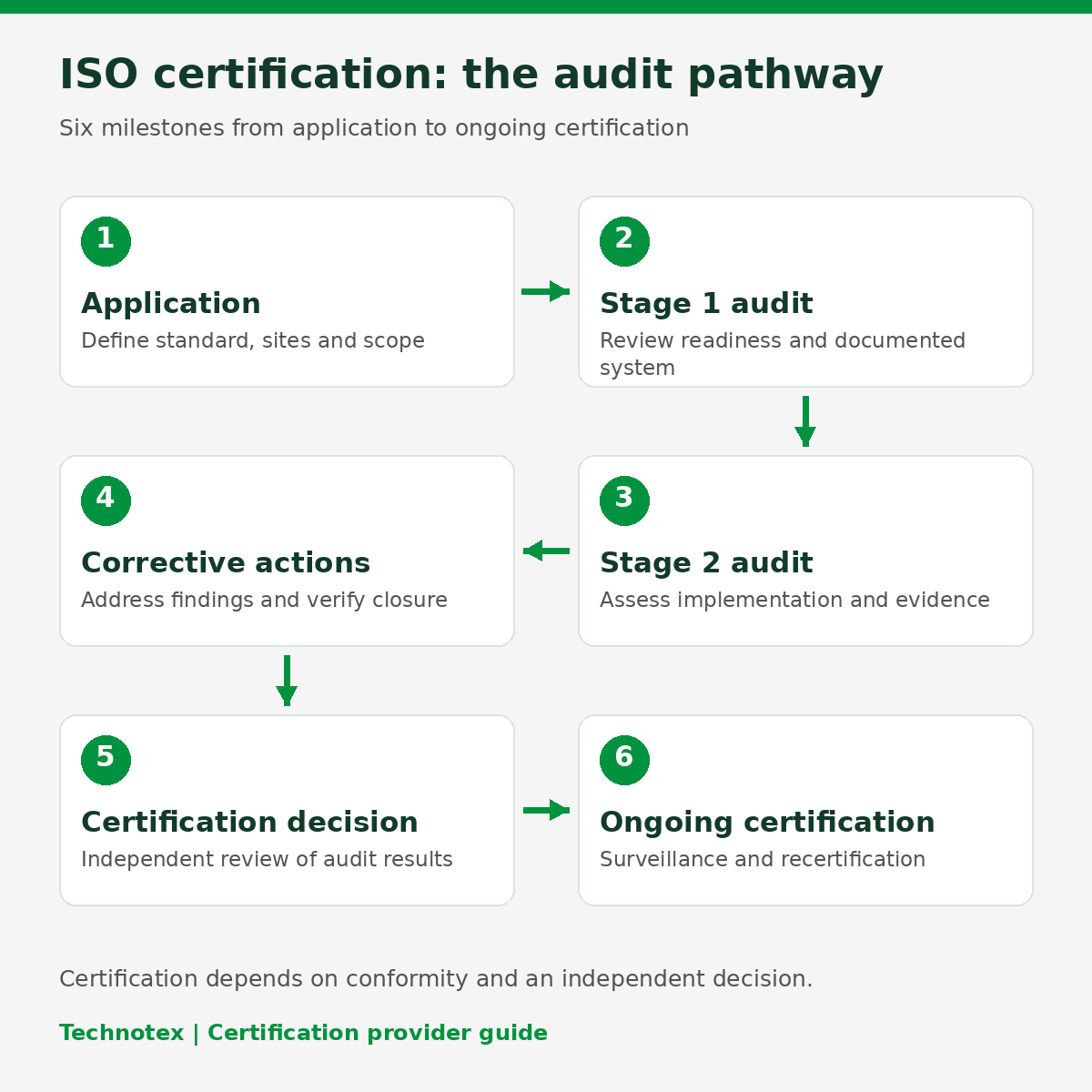
Certification Milestones at a Glance
Follow the audit pathway below. Stage 1 and Stage 2 are separate assessments; addressing findings is followed by an independent certification decision. Surveillance and recertification are part of maintaining certification.
Step 1: Application for Certification
The certification process begins when an organization submits an application to the certification body. The application typically includes information such as:- Organization name
- Business activities
- Number of employees
- Number of operational sites
- Scope of certification
- Applicable ISO standard(s)
- Existing management system information
Step 2: Application Review and Quotation
After receiving the application, the certification body reviews the submitted information to determine whether it can provide certification services within its approved scope. During this stage, the certification body typically:- Reviews business activities
- Determines audit complexity
- Calculates audit duration
- Identifies required auditor competence
- Issues a certification proposal or quotation
Step 3: Stage 1 Audit (Documentation Review)
The Stage 1 Audit is conducted to evaluate whether the organization’s management system is adequately documented and prepared for the certification audit. During Stage 1, auditors generally review:- Management system documentation
- Quality manual (if applicable)
- Policies and objectives
- Risk assessments
- Legal and regulatory requirements
- Internal audit records
- Management review records
- Scope of the management system
Step 4: Stage 2 Certification Audit
The Stage 2 Audit is the primary certification assessment. Auditors evaluate how effectively the management system has been implemented and whether it conforms to the requirements of the applicable ISO standard. The audit usually includes:- Interviews with employees
- Process observations
- Site inspections
- Review of operational records
- Evaluation of process effectiveness
- Assessment of risk management
- Verification of legal compliance where applicable
- Review of continual improvement activities
Step 5: Nonconformities and Corrective Actions
If the audit identifies nonconformities, the organization is required to investigate the root causes and implement appropriate corrective actions. Nonconformities are generally classified according to their significance. Typical examples include:- Missing documented information
- Incomplete records
- Failure to follow documented procedures
- Inadequate risk assessment
- Insufficient monitoring activities
- Lack of employee competence records
Step 6: Certification Decision
Following completion of the audit and review of corrective actions (where required), an independent certification decision is made. If all certification requirements have been satisfied, the certification body issues the ISO certificate for the defined scope of certification. The certificate typically includes:- Organization name
- Certification scope
- Applicable ISO standard
- Certificate number
- Issue date
- Expiry date
Step 7: Surveillance Audits
ISO certification is not a one-time event. To maintain certification, surveillance audits are conducted periodically during the certification cycle. These audits verify that the management system continues to conform to the applicable standard and remains effectively implemented. Surveillance audits typically focus on:- Continual improvement
- Corrective actions
- Customer feedback
- Internal audits
- Management reviews
- Operational performance
- Compliance obligations
Step 8: Recertification Audit
At the end of the certification cycle, a recertification audit is conducted to evaluate the ongoing effectiveness of the management system. Successful completion enables the organization to continue certification for the next certification cycle.Documents and Evidence to Prepare Before the Audit
The evidence required depends on the selected standard and your activities. Start with the management system scope, relevant policies and objectives, process responsibilities, risks and controls, and records showing that the system operates in practice. Avoid buying a generic documentation package that does not match your organization.
- Organization and scope: business identity, locations, employee numbers, key activities and the boundaries of certification.
- Implementation evidence: competence and training records, operational controls, monitoring results and supplier controls where applicable.
- System evaluation: internal audit results, management review records and follow-up on identified issues.
- Standard-specific records: for example, environmental aspects, workplace risk assessments, food safety controls or information security risk treatment, as relevant.
Document names and formats can vary. What matters is whether the information and records meet the applicable requirements and accurately reflect how the organization works. A certification body should explain its application and audit requirements; implementation remains your responsibility.
Track Your Audit Readiness
Use these milestones to review your preparation with the person responsible for your management system. Record the evidence and outstanding actions for each milestone before agreeing an audit schedule.
| Milestone | Evidence to check | Next action |
|---|---|---|
| Define the scope | Activities, locations, standard and management system boundaries | Resolve any unclear scope or site coverage. |
| Implement the system | Responsibilities, policies, objectives, controls and operating records | Close gaps between documented processes and daily work. |
| Evaluate performance | Monitoring, internal audit and management review records | Review results and assign follow-up actions. |
| Address findings | Root-cause analysis, corrective actions and effectiveness checks | Retain evidence that recurring issues have been addressed. |
| Confirm audit arrangements | Application review, intended scope, proposed dates and required evidence | Agree the audit plan with the certification body. |
How Long Does ISO Certification Take?
The certification timeline varies depending on several factors, including:- Organization size
- Number of employees
- Number of operational sites
- Complexity of business processes
- Readiness of the management system
- Number of ISO standards being implemented
Factors Affecting ISO Certification Cost in Bangladesh
Many organizations ask about the cost of ISO certification. There is no fixed price because certification costs depend on the characteristics of each organization. Common factors include:Organization Size
Larger organizations generally require more audit time due to additional employees, departments, and operational activities.Number of Locations
Organizations operating from multiple sites usually require additional audit planning and assessment.Scope of Certification
A broader certification scope may increase audit duration.Industry Risk
High-risk industries often require auditors with specialized technical competence.Number of ISO Standards
Implementing multiple standards, such as ISO 9001, ISO 14001, and ISO 45001, may influence audit planning and duration.Existing Management System
Organizations with established management systems are often better prepared for certification assessments.Compare the Whole Certification Cycle, Not Just the First Fee
| Cost item | Question to ask |
|---|---|
| Initial certification | Does the quoted amount include Stage 1, Stage 2, the certification review and certificate issuance? |
| Surveillance | What ongoing audits and charges apply during the certification cycle? |
| Recertification | Is the renewal audit quoted separately, and when will it be planned? |
| Additional charges | Are travel, taxes, extra sites, follow-up audits or scope changes included or excluded? |
To request a meaningful quotation, provide your business activities, locations, employee numbers, selected standard, intended certification scope and any buyer-specific requirements. Compare quotations against the same scope and audit arrangements. This guide does not publish a fixed price or promise an audit completion date without reviewing those details.
Common Mistakes Organizations Should Avoid
Many certification delays result from avoidable mistakes. Understanding these issues helps organizations prepare more effectively.Treating ISO as a Paper Exercise
Documentation is important, but ISO standards focus on the effective implementation of management systems. Processes should be actively followed throughout the organization rather than existing only on paper.Lack of Top Management Commitment
Leadership plays a critical role in establishing policies, objectives, allocating resources, and promoting continual improvement. Without active management involvement, maintaining an effective management system becomes significantly more challenging.Poor Employee Awareness
Employees should understand:- Organizational policies
- Their responsibilities
- Process objectives
- Relevant procedures
- Quality, environmental, or safety requirements applicable to their work
Ignoring Internal Audits
Internal audits help organizations identify weaknesses before certification audits. Conducting regular internal audits supports continual improvement and helps maintain conformity.Delaying Corrective Actions
Corrective actions should be implemented promptly after identifying nonconformities. Timely action reduces recurring issues and strengthens management system performance.Why Choose Technotex Testing & Quality Assurance Limited?
Selecting the right certification partner is an important decision for any organization seeking internationally recognized management system certification. Technotex Testing & Quality Assurance Limited provides independent third-party management system certification services for organizations across Bangladesh. The organization is committed to:- Professionalism
- Competence
- Impartiality
- Consistency
- Integrity
- Confidentiality
Certification Services
Technotex provides certification services for a range of internationally recognized management system standards, including:- ISO 9001 – Quality Management System
- ISO 14001 – Environmental Management System
- ISO 45001 – Occupational Health and Safety Management System
- ISO 22000 – Food Safety Management System
- ISO/IEC 27001 – Information Security Management System
Industries Served
Technotex works with organizations from various sectors, including:- Ready-made Garments (RMG)
- Textile Manufacturing
- Pharmaceuticals
- Food Processing
- Construction
- Engineering
- Healthcare
- Information Technology
- Logistics and Transportation
- Education
- Hospitality
- Chemical Industries
- Printing and Packaging
- Electrical and Electronics
- Government and Public Sector Organizations
- Service Providers
- Small and Medium Enterprises (SMEs)
Commitment to Continual Improvement
ISO certification should not be viewed as the final destination. Instead, it is part of an ongoing journey of continual improvement. Organizations that regularly review performance, monitor objectives, evaluate risks, and engage employees are better positioned to achieve sustainable growth, improve customer satisfaction, and strengthen long-term business resilience. A well-implemented management system helps organizations adapt to changing market expectations, regulatory requirements, and operational challenges while supporting consistent business performance.How to Verify an ISO Certificate and Accreditation Scope
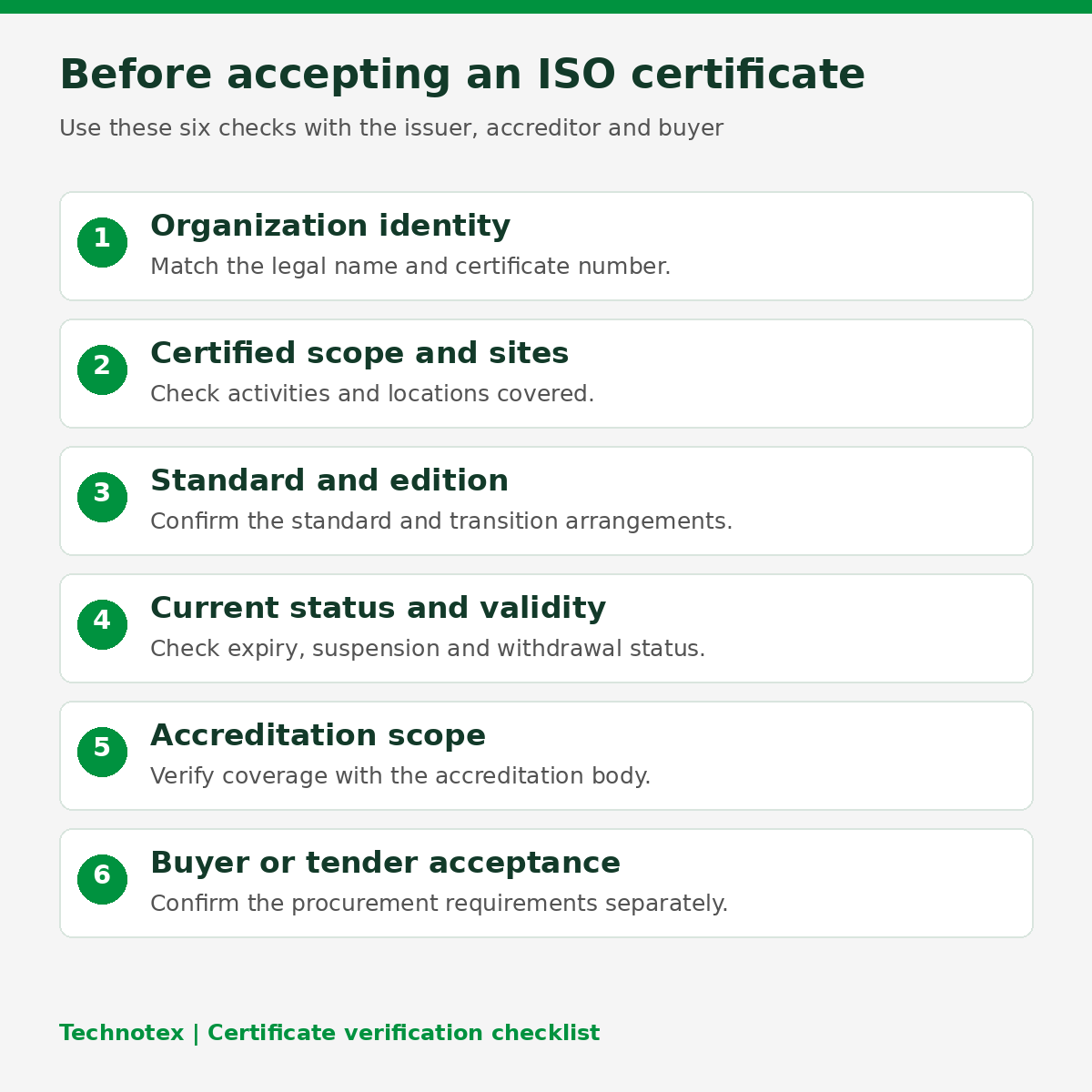
Check the certificate number, legal organization name, standard, certified activities, covered locations and validity dates. Confirm current status with the issuing body and check its accreditation scope with the relevant accreditation body. A logo or scanned certificate alone is not enough.
For Technotex, use the certificate verification page and review the accreditation and recognition information. If a lookup is inconclusive, contact Technotex with the certificate number. Confirm acceptance separately with your buyer; accreditation and buyer acceptance are different checks. ISO also provides official guidance on selecting a certification body and verifying certification.
Check the Applicable Standard Edition
ISO now lists ISO 9001:2026 as a published edition. For a new application or an existing ISO 9001 certificate, ask your certification body which edition and transition arrangements apply. Publication of an updated standard does not, by itself, establish your certificate’s transition deadline.
Practical ISO Certification Guides for Businesses in Bangladesh
Use these focused resources to prepare a quotation brief, organize audit evidence and check certificate details.
Frequently Asked Questions (FAQs)
Who issues ISO certification in Bangladesh?
An ISO Certification Provider in Bangladesh is an independent third-party organization that assesses whether an organization’s management system conforms to the requirements of a specific ISO standard. If the applicable requirements are met, the certification body issues an ISO certificate for the defined scope of certification.
What is the difference between ISO and an ISO certification provider?
The International Organization for Standardization (ISO) develops international standards. ISO itself does not issue certificates. Independent certification bodies conduct audits and issue certificates after successful assessment.
Why should my company obtain ISO certification?
ISO certification can help organizations improve operational efficiency, enhance customer confidence, strengthen risk management, support continual improvement, and demonstrate conformity with internationally recognized management system standards.
Which ISO standard is best for my business?
The appropriate ISO standard depends on your organization’s activities and objectives.
Examples include:
- ISO 9001 – Quality Management
- ISO 14001 – Environmental Management
- ISO 45001 – Occupational Health and Safety
- ISO 22000 – Food Safety
- ISO/IEC 27001 – Information Security
Many organizations implement more than one standard through an Integrated Management System (IMS).
How long does ISO certification take?
The certification timeline depends on factors such as organization size, business complexity, number of locations, management system maturity, and the applicable ISO standard.
How much does ISO certification cost in Bangladesh?
Certification costs vary depending on:
- Organization size
- Number of employees
- Number of sites
- Certification scope
- Applicable ISO standard(s)
- Audit duration
The best approach is to request a quotation based on your organization’s specific requirements.
Is ISO certification mandatory?
In many industries, ISO certification is voluntary. However, customers, government agencies, regulators, or international buyers may require certification as part of contractual or procurement requirements.
How long is an ISO certificate valid?
ISO certification is typically maintained through a certification cycle that includes periodic surveillance audits and a recertification audit at the end of the cycle.
Can small businesses obtain ISO certification?
Yes. Small and medium-sized enterprises (SMEs) can implement ISO management systems. The requirements are scalable and can be applied to organizations of different sizes and sectors.
Why choose Technotex Testing & Quality Assurance Limited?
Technotex Testing & Quality Assurance Limited provides independent third-party management system certification services with a commitment to competence, impartiality, consistency, and professionalism. Certification activities are conducted in accordance with applicable international standards and within the approved scope of accreditation.
Will every buyer accept an accredited ISO certificate?
No. Acceptance depends on the buyer’s or tender authority’s stated requirements. Confirm the required standard, scope, locations and accreditation arrangements with the buyer before purchasing certification services.
How do I check the accreditation scope of a certification provider?
Request the provider’s current accreditation details and confirm them with the named accreditation body. Check coverage for the requested standard and relevant activities, rather than relying on a logo or a broad accreditation claim.
Are surveillance audits included in the initial certification price?
They may be quoted separately. Ask for an itemised quotation covering initial certification, ongoing surveillance, recertification and any travel or follow-up charges. Review the agreement before committing.
What should I send when requesting an ISO certification quotation?
Provide your selected standard, business activities, employee numbers, operating locations, intended scope and any buyer or tender requirements. These details help the certification body review the application and plan an appropriate audit.
Why Organizations Trust Technotex
Organizations across Bangladesh choose Technotex Testing & Quality Assurance Limited because of its professional approach to certification and commitment to delivering impartial, reliable, and internationally recognized management system certification services. Our strengths include:- Independent third-party certification
- Competent and experienced audit teams
- Transparent certification process
- Timely communication
- Professional customer support
- Industry-specific audit competence
- Commitment to impartiality and confidentiality
- Certification services aligned with applicable international standards
- Focus on long-term client relationships
Discuss Your ISO Certification Requirements
Selecting the right ISO Certification Provider in Bangladesh is a strategic decision that can influence your organization’s credibility, operational performance, and long-term success. ISO certification is more than a certificate—it is a framework for continual improvement, risk management, customer satisfaction, and sustainable business growth. Organizations that implement internationally recognized management systems are often better equipped to improve operational consistency, strengthen stakeholder confidence, meet customer requirements, and compete in local and global markets. If your organization is planning to achieve ISO certification, partnering with a competent and impartial certification body is an important step toward building trust and demonstrating your commitment to internationally accepted management practices. Technotex Testing & Quality Assurance Limited is dedicated to providing independent third-party management system certification services for organizations across Bangladesh. By combining competence, professionalism, impartiality, and consistency, Technotex supports organizations throughout the certification process while maintaining the integrity of certification activities.Request a certification quotation from Technotex. Include your standard, business activities, employee numbers, locations and intended scope so the team can review your requirements. Certification remains subject to audit findings and an independent decision.