Verify an ISO Certificate in Bangladesh: 5 Essential Checks
ISO certificate verification in Bangladesh involves checking the issuing body, certified organization, standard, scope, locations and current status. A certificate image or logo is a starting point for a check. It does not establish that a specific factory, activity or supplier contract is covered.
Use these five checks to verify an ISO certificate in Bangladesh and record the evidence behind your procurement decision. It also explains what to do when a certificate cannot be found online. For the wider selection process, read our ISO certification in Bangladesh provider guide.
Step 1: Verify an ISO Certificate in Bangladesh Against Supplier Identity
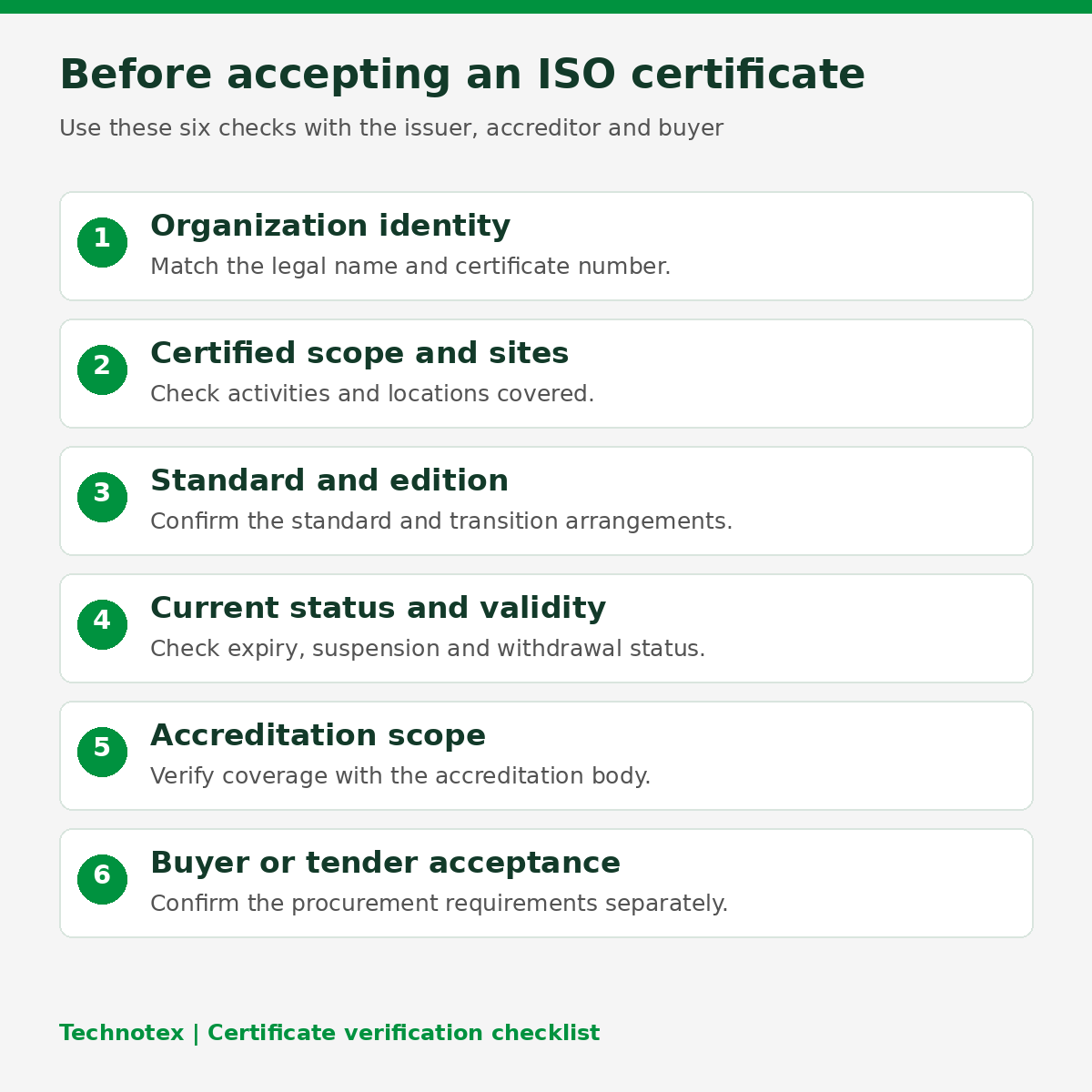
To verify an ISO certificate in Bangladesh, obtain a readable certificate and any accompanying schedule or annex. Record the certificate number, legal organization name and address. Compare them with the entity supplying your goods or services. Similar trading names, related companies and shared branding can make a mismatch easy to overlook.
If the certificate names a parent company, ask whether the contracting subsidiary is included. If your purchase concerns a particular facility, check that facility rather than relying on the head office address. Request clarification in writing and keep the response with the supplier evaluation record.
This is a verification task, not an accusation. Ask clear questions about any differences. A company may have changed its name or moved a site, but those changes should be resolved through the issuer’s records and the relevant certification arrangements rather than assumed from a seller’s explanation.
Step 2: Review the Standard, Scope and Covered Sites
Read the complete scope statement. Does it describe the activity you are buying? For example, a certificate covering distribution may not establish that the manufacturing facility is within scope. A service provider’s certification may cover one business unit rather than every service advertised on its website.
Compare the standard and edition with your procurement requirements. Management system certification should not be described as proof that every individual product has been tested or approved. If you need product-specific conformity evidence, identify that requirement separately and ask for the appropriate records.
Check any schedule listing additional sites. Keep that schedule with the certificate rather than saving only the first page. If a location is missing, request confirmation from the issuing body before recording it as covered. The certificate’s scope and supporting records should answer the actual purchasing question.
Step 3: Identify the Issuer and Verify Accreditation Claims
ISO develops standards; it does not issue certification certificates. An external certification body is the issuer. Locate that body’s official website independently and confirm the relevant contact or verification route. Do not rely exclusively on a contact number embedded in an unfamiliar document.
Certification and accreditation are different. Accreditation provides an independent assessment of a conformity assessment body’s competence. Where accredited certification is required, verify the relevant accreditation body and the certification body’s scope. A broad claim of “international accreditation” does not answer whether the requested standard and activities are included.
ISO’s official certification guidance identifies IAF CertSearch and direct contact with the relevant certification or accreditation body as verification routes. Use the appropriate route for the claimed accreditation arrangement. Do not assume every certificate is searchable in every database.
Record what you verified and where. If a tender names a specific accreditation arrangement, compare the evidence against that exact requirement. Do not substitute a different arrangement because its logo looks familiar. Ask the buyer or tender authority to clarify acceptance where the requirement is ambiguous.
Step 4: Confirm Current Status, Not Only the Printed Date
When you verify an ISO certificate in Bangladesh, look up the certificate number and compare the returned organization, scope and dates with the document you received. Record when the lookup was performed. A certificate may have been superseded, withdrawn or suspended even though the printed expiry date has not passed. Resolve discrepancies with the issuer.
If the lookup returns several entries, identify the one matching the organization and certificate. Do not select an entry merely because it contains the same company name. Check the standard, site and scope. Save an appropriate verification reference or correspondence according to your procurement record policy.
Where the assessment is time-sensitive, repeat the status check at the relevant purchasing milestone. A check performed when a supplier first registers may be insufficient for a later contract decision. Set the review interval according to the importance of the certification requirement and your procurement controls.
Step 5: Keep a Record to Verify an ISO Certificate in Bangladesh
The following worksheet is a blank operational template. It contains no claimed supplier statistics or validation results. Complete it using the certificate, independent lookup and written confirmations you obtain. Separate confirmed facts from unresolved questions.
| Field | Evidence or value to record | Review status |
|---|---|---|
| Organization identity | Legal name and relevant address | Confirmed / unresolved |
| Certificate number | Exact reference, including prefixes | Confirmed / unresolved |
| Standard and edition | Certificate detail and buyer requirement | Confirmed / unresolved |
| Scope and sites | Full statement and supporting schedule | Confirmed / unresolved |
| Issuing body | Independently located official contact | Confirmed / unresolved |
| Accreditation claim | Relevant directory or written confirmation | Confirmed / unresolved |
| Current status | Lookup result or issuer response | Confirmed / unresolved |
| Buyer acceptance | Procurement condition and decision | Confirmed / unresolved |
| Review details | Reviewer, date and next review trigger | Recorded / missing |
A practical outcome can be “verified against stated requirements,” “clarification required” or “does not meet stated requirements.” Describe the basis for the outcome. If information remains unresolved, do not silently convert that uncertainty into a positive verification result.
What If the Certificate Is Not Found Online?
A missing search result is a reason to investigate. It is not, by itself, proof of a fake certificate. Check spelling, certificate prefixes, legal names and the database being used. Confirm whether the selected database is relevant to the issuer’s claimed accreditation arrangement.
Then contact the issuing certification body through an independently located official channel. Provide the certificate number, organization, standard and scope, and ask for current status confirmation. Where necessary, ask the accreditation body to confirm the certification body’s relevant accreditation scope.
If responses conflict with the certificate, pause the acceptance decision and record the discrepancy. Follow your supplier escalation process. Avoid making a public allegation based solely on an incomplete lookup; procurement needs a documented resolution, not a conclusion drawn from one unsuccessful search.
Warning Signs That Deserve Further Checks
- The certified organization differs from the contracting supplier without a documented explanation.
- The scope does not cover the activity or location relevant to the purchase.
- The verification link leads to an unrelated or unofficial website.
- The issuer cannot confirm the number or current status.
- Accreditation is claimed without relevant scope evidence.
- The seller promises that a certificate is accepted by every buyer.
These are investigation prompts rather than a definitive fraud test. Keep copies of the information assessed and the questions sent. A clearly documented unresolved issue is more useful than a confident statement unsupported by evidence.
Check Buyer Acceptance Before Applying for Certification
Organizations seeking certification can use the same checklist before choosing a provider. Ask a prospective buyer what standard, scope, sites and accreditation arrangement it requires. Share those requirements with the certification body during application. This reduces the chance of purchasing an assessment that does not meet the intended procurement need.
Include these requirements in your quotation brief and compare exclusions. Read our ISO certification cost and quotation guide and document readiness checklist to organize the next steps.
How to Verify an ISO Certificate in Bangladesh: FAQs
Does ISO issue certificates directly?
No. Certification is carried out by external certification bodies. ISO develops standards.
Does an expiry date establish that a certificate is currently active?
No. Confirm current status through the issuer or a relevant verification route, including any suspension or withdrawal information.
Does a missing database result prove a certificate is false?
No. Check the search details and database coverage, then obtain confirmation from the issuing body and relevant accreditation body where necessary.
Does ISO 9001 certification prove every product is certified?
Management system certification and product-specific certification are different. Check the exact scope and the evidence required for the product.
Will every buyer accept the same certificate?
Acceptance depends on the buyer’s requirements. Confirm the standard, scope, locations and accreditation arrangement before committing.
Discuss Certification Requirements with Technotex
When discussing a proposal with Technotex Testing & Quality Assurance Limited, provide your scope and buyer requirements and ask how issued certificate status can be checked. For a complete provider comparison framework, visit the ISO certification in Bangladesh guide.