
ISO 9001:2026 Published: Key Changes and Transition Guide
ISO 9001:2026 was officially published on 16 September 2026, replacing the 2015 edition of the quality management systems standard. Organizations certified against ISO 9001:2015 should now review the published requirements and plan their transition. This guide summarizes the main changes, practical preparation steps and the formal transition deadline of 30 September 2029.
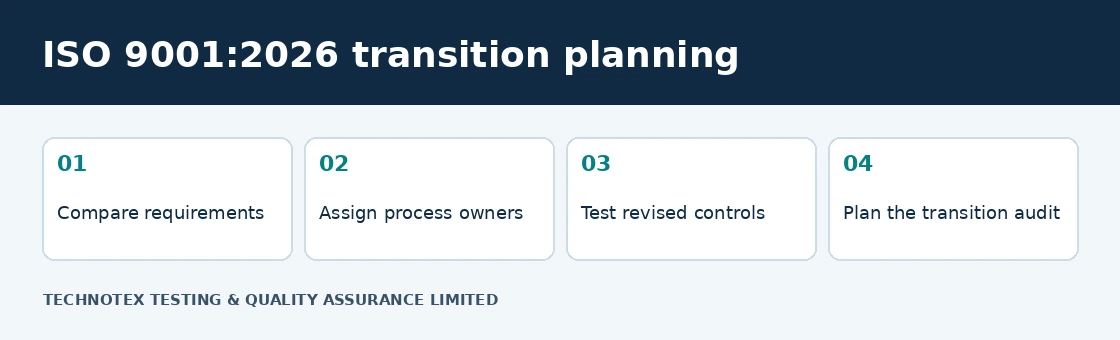
Key Changes in the Published ISO 9001:2026 Standard
The published ISO 9001:2026 edition includes targeted updates designed to enhance alignment with the harmonized structure used across other ISO management system standards (MSS). These updates aim to improve clarity, consistency, and relevance in today’s evolving business and environmental context.
Key Changes Include:
- Section 5.1 – Leadership and Commitment: Updated to emphasize the promotion of a quality culture and ethical behavior. Enhanced guidance has been added to help organizations demonstrate these principles effectively.
- Clause 6.1 – Actions to Address Risks and Opportunities: Now features a clearer separation between risk and opportunity management, divided into new subclauses (6.1.1 to 6.1.3) with expanded explanatory notes.
- Climate Change Integration: The climate change amendments introduced in 2024 (previously referenced in clauses 4.1 and 4.2) have been fully incorporated into the standard.
- Clarified Requirements: Multiple clauses across Sections 4 to 10 have been refined to provide clearer expectations. Additional notes and examples have been included to improve interpretation and implementation.
- Expanded Annex A: The annex has been significantly expanded to offer more detailed guidance aligned with clauses 4–10, providing better support for practical application.
The revised edition preserves the familiar management system framework while strengthening clarity around leadership, quality culture, risk and opportunity management. Organizations should review the published standard against their existing processes, rather than relying on summaries of earlier drafts.
Transition Timeline
The Global Accreditation Cooperation (Global ACI) transition requirements establish a deadline of 30 September 2029 for accredited certificates transitioning from ISO 9001:2015 to ISO 9001:2026. Accredited certification bodies need to complete their accreditation transition by 30 September 2027. From 31 March 2028, new and initial accredited certifications are to be issued against ISO 9001:2026. Organizations should agree their transition audit arrangements with their certification body well before the deadline.
Existing ISO 9001:2015 accredited certificates may remain valid within the approved transition period, subject to normal surveillance, current certification status and applicable scheme rules. Certification is not automatically extended merely because a transition window exists.
Official Sources and Further Reading
Check the ISO announcement dated 16 September 2026 for publication details and the Global ACI transition requirements for the latest accreditation transition framework.
Plan the ISO 9001:2026 transition audit
Start with the published requirements and a map of the processes already covered by your quality management system. Review each process with the people who perform it and record where they already have supporting evidence. This makes it easier to keep effective practices and direct the transition work toward areas that need attention.
Use a transition register with columns for the affected process, current evidence, action, owner and due date. For each action, specify what evidence will demonstrate that the change has been put into use. If the review finds that the process already addresses a requirement, record the supporting evidence and keep the existing arrangement.
For example, an apparel supplier may track customer complaints, returns and repeated defects in separate records. A transition review may find that managers seldom consider those records together. The quality lead could consolidate them for management review, assign actions where issues recur and sample a later production run to see whether the actions addressed the issue.
Give process owners time to apply revised controls before the transition audit. For a change to supplier evaluation, review completed evaluations against the revised procedure. For a change to management review, check whether meeting records show decisions, ownership and follow-up. Internal auditors can sample completed records and document any inconsistencies that still need attention.
For organizations with multiple sites, confirm who implements the revised processes at each site and how the central team checks their use. A common procedure can cover multiple sites while the evidence varies by location. Ask each site to keep examples from its own operations and track open actions in the same transition register.
Discuss the expected readiness date with your certification body. Share the current scope and sites and ask whether the transition can be scheduled alongside surveillance or recertification. Request the proposed schedule and document requirements in writing so internal checks and staff availability can be planned around them.
If customers ask about the transition, communicate the current certificate status and confirmed audit arrangements. After the certification body issues its decision, check the legal entity, scope and locations on any updated documentation before distributing it or replacing the copy in a customer portal.
Worked example for a quality management system transition
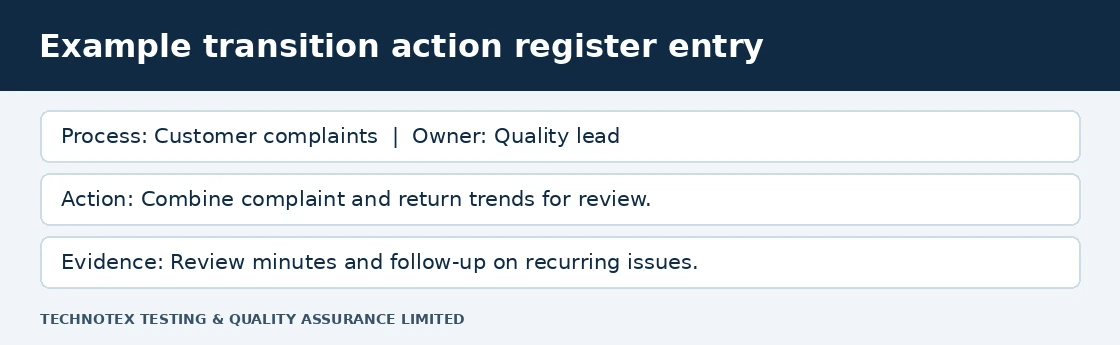
Consider a manufacturer with two production sites and a single quality team. The central team can keep one transition register while assigning work to the people who run each process. For customer complaints, the quality lead might consolidate complaint and return trends for review. At each site, the local owner can show how the agreed action was implemented and where the follow-up evidence is kept.
Use the register to separate implementation from verification. Updating a procedure shows that an action was issued. Reviewing completed work against that procedure shows whether it was used. Assign the second check to someone who can examine completed records and discuss exceptions with the people involved. If the evidence is incomplete, record the remaining step and a new review date.
Include one example from regular operations in the evidence pack. If a customer complaint led to a process change, keep the complaint record, decision, assigned action and evidence from a later check. This helps explain how the process works across departments without relying on a list of newly issued procedures.
Review readiness with process owners
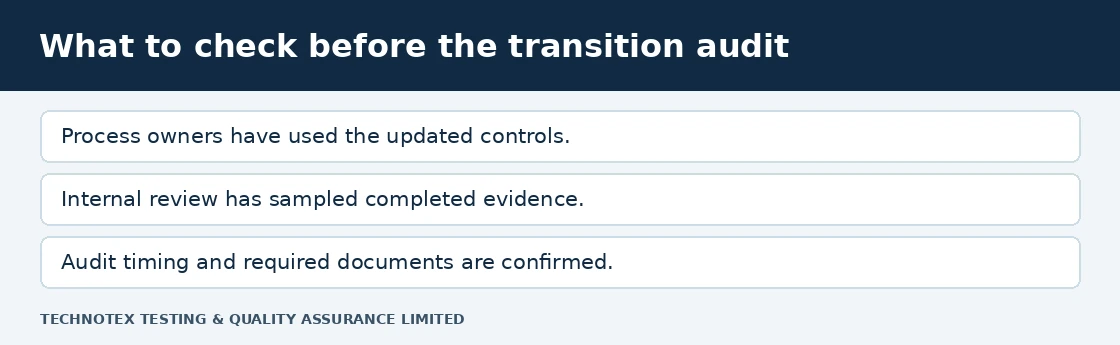
Before the audit, review the register with the people responsible for open actions. Check which changes have been used in normal work, which evidence has been sampled, and whether any site needs more time. If the certification body asks for documents in advance, confirm who will compile the response and which version will be sent.
Decide who will answer questions during the audit about customer feedback, supplier controls and management decisions. A process owner should be able to locate the relevant evidence and explain how a recent decision was made. If several sites use the same procedure, prepare a site-specific example for each location included in the audit scope.
After the internal readiness review, record the agreed schedule and communicate it to the teams involved. Keep a copy of the certification body’s instructions with the transition register. Review outstanding evidence again before submission, especially where responsibility was handed from one site or department to another.
Conclusion
The ISO 9001:2026 revision continues to reinforce the foundation of quality management by integrating emerging global priorities—such as ethics, risk management, and climate change considerations—into its framework.
Organizations should begin a documented gap analysis, revise procedures where necessary, train relevant personnel and coordinate the transition audit with their certification body. Read our ISO 9001 certification guide for Bangladesh for broader preparation steps.
Stay informed: Follow Technotex Testing & Quality Assurance Limited for updates and professional guidance on the ISO 9001:2026 transition process.